Crew Blog | Joey Mallott: Joining Hōkūleʻa from Alaska

Blog by Joey Mallott

Hōkūleʻa, thankfully, has been a large part of my life dating back to the mid 1990’s when PVS leadership approached a respected elder of my tribe about the possibility of logs for a voyaging canoe. My people, the Tlingits from Southeast Alaska, did not hesitate to donate logs to PVS, eventually being carved and crafted into the two beautiful hulls of the waʻa Hawaiʻiloa.

Fast forward to present time. I am sailing on Hōkūleʻa for my third long distance voyage. My first was over 17 years ago from Tahiti to Molokai, which was about 24 days on the open ocean. That voyage was an honor and everlasting memory that I will cherish always. My second was just 2 years ago as apart of the current Mālama Honua Worldwide Voyage, which took us on a journey up the East Coast of the North Island, Aotearoa. Now, I sit on the deck of Hōkūleʻa once again, today being the twelfth day of Leg 29 from Rapa Nui to Tahiti.

We have stayed on a westward course since leaving Rapa Nui. The sailing has been pleasant, except there have been some days of light winds and little miles gained. The first few days of any voyage seem to go slowly, but after about a week, the whole crew seems to fall into a very efficient routine. Often our assigned duties during watch rotate from steering on the hoe, swapping out jib sails, closing and opening of the main and mizzen, scrubbing the decks, cooking 3 meals a day, cleaning up after ourselves and each other, all of which makes the days fly by. The crew starts to ask each other, “Hey, what day is it?” or, ” How many days have we been sailing now?”

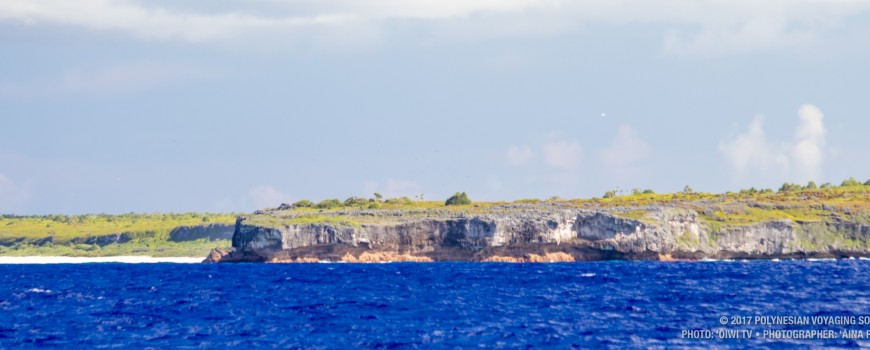
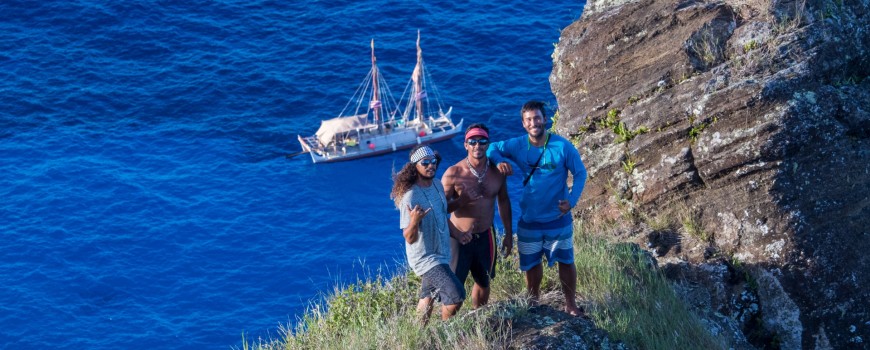
Strangely, we have seen little sea life. Early on, we caught a few fish, but we haven’t hooked anything for over a week now. As we passed the tiny atoll of Ducie, which is in route to Pitcairn, we finally crossed paths with several types of birds that helped reassure the navigator that we are on the correct course. The next day, we were in on the hunt for Henderson, another tiny atoll, this one about 100ft in height. As we sailed slowly, scanning the horizon, a sudden surprise literally surfaced to show us the way.

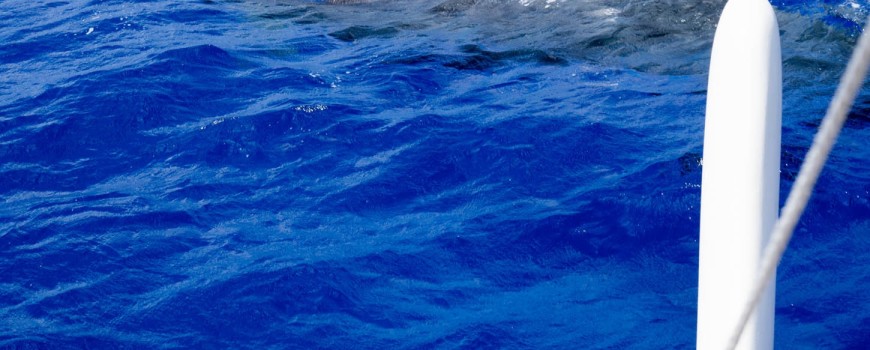
Monster sperm whales, three of them, were spotted in the distance, but right then, two swam right in front of our bow and we got a very special up-close look at a pod of these beautiful, majestic creatures.

With that event in mind, it occurs to me that what Hōkūleʻa does is nothing short of spectacular. All the volunteer and public support PVS receives and what each of the 29 different crews so far have been able to accomplish is nothing close to routine. The vision of Mālama Honua is so profound and at the same time so simple that the message connects with anyone who comes and visits the canoe in port or on the website. So, the long days in the sun, the sleep deprived nights, callous hands, and saltwater showers are all worth it, and, of course, it is an honor to help spread Hōkūleʻa’s message of Mālama Honua.


Homecoming - Save the Date - Banner Feb 17 Update

Hōkūle‘a Homecoming – Save the Date

We’ve got more details for you regarding Hōkūleʻa’s historic homecoming in June 2017! Click below to find out more:
Crew Blog | Keoni Kuoha: Learning and Knowing

Keoni enjoying the afternoonCrew blog by Keoni Kuoha

It’s been a while since I’ve sailed long-distance aboard Hōkūleʻa. Actually, it’s been exactly ten years. Spring 2007. We were sailing through Micronesia on our way to Satawal and the ceremonial graduation of our Hawaiian navigators as pwo.

Hard to believe it’s been ten whole years. Well, except, these hands know it’s been ten years. My callouses are only now returning after a week at sea and my palms have taken these same days to get reacquainted with the ache that comes with handling the steering sweep for hours on end. These feet know it’s been ten years, my soles slowly cracking by the multiple cycles of wet and dry that are as constant as the southern swells that lift these double hulls. And this skin knows it’s been ten years. It turns from pasty to papaʻa, a thin crust of salt settled in every pore. Yet, the knowledge kept in these hands, these feet, and this skin persists–keeping course, holding fast, and reveling in the elements of the open ocean. There’s a persistence to knowing, and the knowing cultivated in me through years of voyaging is something I continue to carry with me. Always.

But aren’t we all like this? Previous knowledge guiding our every action, framing our view of the world around us. Of course, our knowing isn’t usually born of voyaging aboard Hōkūleʻa, but that doesn’t make it any less impactful. What each of us know and do with that knowing is powerful, and our ways of knowing and acting are all products of how we come to know (i.e. learning). How I come to know–and continue to learn–determines what I know and what I do with that knowing. In my learning through voyaging, I have created in me a lens on the world that is fundamentally different from the other lenses of my knowing, and each of these lenses tend toward different outcomes.

Speaking of outcomes, if you’ve been following this blog for any length of time, you know that mālama honua is both the theme and the hope of this present voyage. We need to care for this planet and the places we call home. The maintenance and expansion of our wellbeing as a planet needs to be our priority, which brings us back to the impact our knowing has on us and the world around us. We need to be ever more discerning of our mechanisms and methods of learning if positive change is going to happen. Now more than ever, as change becomes the defining feature of our society, the purposeful crafting of our learning systems become critical to our meaningful progress as a species.

Through the course of this voyage, I see examples of learning systems for a better future. Over the past few nights, Bruce Blankenfeld, master navigator and onboard professor, has been taking time in the early evenings to talk about the processes of wayfinding. The concepts are complex and intermeshed, but taken in pieces and offered in the context of an active voyage, the learners find continuous opportunity to associate these new concepts with real world application. We begin to understand the concepts. But, just as importantly, we’re constantly met with new questions and challenges to previous understandings. Green laser in hand, Bruce identifies a pair of pointer stars who, when they reach their apex in the sky, point true north. I take the steering sweep a little later and am challenged to see those same stars, but the professor is there to reorient my eyes to their intended target. I notice new characteristics in the pointer stars’ locale, building new knowledge–well, at least it’s new to me. As the crew takes in Bruce’s every word, our learning extends far beyond the original lesson: personal stories are woven with the sound of wave-wash sliding across the paddle’s blade, relationships are deepened and plans made for future collaborations, scattered clouds blur lines between the known and unknown, and two new pointer stars are emblazoned in my memory.

ʻAʻole i pau…


Homecoming - Save the Date - Banner Feb 17 Update

Hōkūle‘a Homecoming – Save the Date

Sign up for updates and be the first to know as we continue to detail homecoming festivities during the week of Hōkūleʻa’s homecoming
in June 2017!

Hikianalia Update | March 27, 2017

Kaipo KiahaBlog by Kaipo Kiaha

As is ritual on any deep sea voyage, our crew put away our wrist watches in order to rely on the elements to determine the time of day (even the computer I write this on has had its time set to a random hour, and the clock in the menu bar is hidden).

While on land, we are bound to the human construct of time. It tells us when to wake up, if we are late or early, and whether to feel nervous or impatient because of those things. When in reality, time is a made up idea based on the movement of the sun, moon, planets and stars. So by giving up this notion of time, we are surrendering to the primordial reign of the deep sea and the surrounding celestial bodies. We are living on waʻa time.

Waʻa time means you get up when you are on watch, and you go to sleep when you are off watch. It is roughly broken up in three: 6-10, 10-2, 2-6. However, these times are estimated. So really, if your watch is 2-6, you might actually be up from 1:30-6, or 2-6:30, or any other similar variation. While on land in our daily lives, being 15 or 30 minutes late to something might be a big deal. But on waʻa time, it doesn’t matter. And that is where the magic lies.

By giving up something as simple and ever present in our daily lives as a clock, we are able to focus that much more on the voyage itself. We get up not to be “on time,” but to relieve the crew before us who worked hard for 4 hours, because we care about them. We take the time to pray before meals, to serve food to our fellow crew members, and then wash their dishes. We take the time to check in on each other, and to make sure everyone is feeling okay. But perhaps most of all, we take the time to find joy in, and fully appreciate this amazing opportunity we all get to be a part of.

And now for some sailor-speak:

We have continued on our course of Manu/Nālani Malanai, averaging between 7 and 8 knots over the past 24 hours. We have estimated two positions (plotted on our navigation chart station), and covered almost 170 nautical miles. We’ve had a decent amount of cloud cover last night and throughout today, sometimes having complete cloud cover and other times around 50%. We ran into a few squalls last night and mid-morning today, but Hikianalia sailed through them swiftly.

The hoe ʻuli is still tied down, as our current sail set (main, mizzen, #16 and #7 jibs) and weight distribution is allowing Hikianalia to correct herself and hold the course line, rolling through the 8-10 foot swells out of Hikina and 20 knot wind out of Lā Koʻolau.

We saw a pod of pilot whales around 1pm this afternoon and some of them got close to the canoe but stayed underwater. Unfortunately I was too slow on the camera shutter to catch any good shots.

Our navigation team is using a dead reckoning system to check heading and speed, and coming up with a consensus on the average and estimating a position from there. However, since we have Hōkūpaʻa, we will use that to determine a more accurate latitudinal position at night.

We are expecting this wind to hold up until we get to the ITCZ, around 9 degrees north. We estimate we are just below 18 degrees at the moment, and we are trying to gain easting and maintain a fast speed in order to counteract the prevailing westerly current leading us leeward.

That being said, this first day at sea should give us an idea of what to expect over the next few days until we hit the ITCZ. All I can say is, it’s been great so far, and we are looking forward to the rest of our journey.


Homecoming - Save the Date - Banner Feb 17 Update

Hōkūle‘a Homecoming – Save the Date

We’ve got more details for you regarding Hōkūleʻa’s historic homecoming in June 2017! Click below to find out more:

Hikianalia’s Hilo Departure

Kaipo KiahaBlog by Kaipo Kiaha

This morning some of us awoke before the sun, where a steady Hilo rain was pattering on the deck. This would turn out to be a blessing for us on our last morning, as once the sun rose, the clouds parted and the rain stopped. There was a feeling of somberness in the air as we all had the same thing on our mind: departure.

Uncle Gary Yuen made us a hearty breakfast of banana pancakes and pork omelettes with the leftover kalua pig from the night before, when the Keaukaha community hosted us for dinner tonight on the shore of Palekai, where we ate puaʻa, rice, watercress salad, and Uncle Gary’s stew.  ʻAwa was also shared, which should help us sleep well tonight on our last night on land.

At breakfast, Kālepa laid out the plan for the day and after breakfast we made ready to go to ʻImiloa Astronomy Center. Once we arrived at ʻImiloa, we gathered into their state of the art planetarium. Here, Kālepa spent a couple hours going over our sail plan in detail, as well as briefly reviewing the night sky at various latitudes, making sure to note the stars that each watch would be able to use. At the end, Watch Captain Kalani Kahalioumi gifted each crewmember with a nice green Hawaiʻi-Tahiti Hikianalia Crew dry fit shirt as well as a Keaukaha T-Shirt.

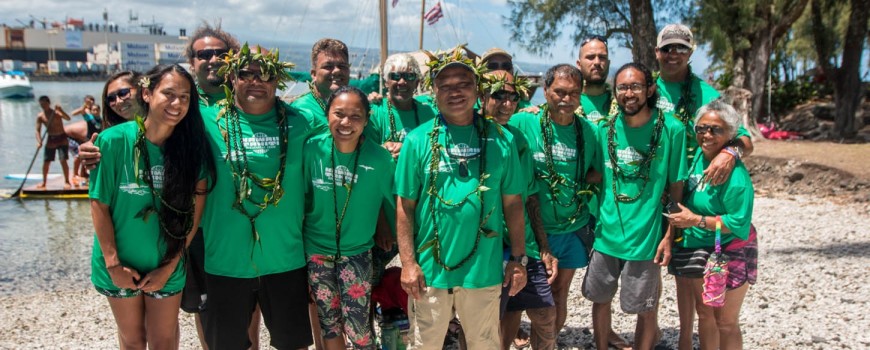
When we returned to Palekai a little before noon, a small crowd had already begun to gather. Mostly family and friends, members of the Hawaiʻi Island and ʻOhana Waʻa communities, and lots of keiki and kūpuna. We spent our last moments relaxing and spending time with those we would leave behind, before gathering as a crew on the waterline to pule as one ʻohana. Our crew, dressed in green, circled up as elders and leaders gave words of inspiration. Kālepa introduced his daughter as captain, and Kalā gave a moving speech, thanking her mentors and reminding all of us that we follow the footsteps of Papa Mau.

After the last pule, we said our final goodbyes (maybe two or three times over) and then headed back to Hikianalia. We pulled up anchor, let go of our offshore lines, motored out, then picked up tow in the bay. While under tow by the vessel Tuna Time, ʻawa was shared, and Uncle Gary cooked us some chicken papaya soup on rice and Jackie Meggs made a salad and her own dressing. We also had some more of that paʻi ʻai from Kalā Thomas and the Kānehūnāmoku Farm.

We towed down to Kumukahi as the sun set off our starboard beam. We have just broke tow and set our sails. We have the main and mizzen up, with the working jib on the outer head stay (appropriately named Palekai), and a storm job on the inner head stay. Our heading is Nā Leo Malanai, and we have Ke Kā o Makaliʻi in the sky, as well as Hōkūpaʻa to guide us south to our destination. Some of the city lights are still visible against the dark partly cloudy night sky, and these will be the last signs of land we will see for at least a couple weeks.

Our crew is feeling excited at the beginning of this journey, as we can only imagine what lies ahead for us. To all of you back home, mahalo for allowing us to go, and for making the dream possible.


Homecoming - Save the Date - Banner Feb 17 Update

Hōkūle‘a Homecoming – Save the Date

We’ve got more details for you regarding Hōkūleʻa’s historic homecoming in June 2017! Click below to find out more:
Pitcairn Islands – Mālama Honua Connections

Recently, Hōkūleʻa and her crew visited the Pitcairn Islands for the second time in Hōkūleʻa’s 42-year voyaging history, sailing through the Pitcairn Islands Marine Reserve. At roughly 3 ½ times the size of the land area of the U.K., the Pitcairn Islands Marine Reserve protects some of the most pristine marine ecosystems of Island Earth. The waters are home to 1,249 identified species, including a few found nowhere else on Earth. The reserve also safeguards one of the world’s only two remaining raised coral atoll as well as 40-Mile Reef, the deepest and most well-developed coral reef known.

But even for wealthy nations, enforcement of reserve rules—such as prohibitions on commercial fishing and seafloor mining—in such a remote area is challenging and expensive. To address that issue, new methods and cutting-edge technologies have been used to develop an enforcement strategy for this reserve.

In January 2016, Liquid Robotics partnered with the UK Foreign & Commonwealth Office and companies to deploy a Wave Glider to surveil Pitcairn Island’s protected areas. Liquid Robotics’ Wave Glider is a hybrid wave- and solar-powered unmanned surface vehicle designed to help protect marine protected areas from illegal fishing as well as to perform environmental science research and monitoring, powered only by nature.

Initial testing yielded incredible results. The Wave Glider was able to acoustically detect vessels across 18 nautical miles with underwater hydrophones and was able to successfully communicate data and work with satellites data during the entirety of the operation, to help detect vessels and illegal incursions in the 324,000 square mile protected area.

The success of the Pitcairn Islands mission demonstrated to Liquid Robotics, the United Kingdom and the entire illegal fishing community the potential for unmanned systems in conducting persistent monitoring and surveillance missions to combat illegal fishing.

Even with progress like this, only about 3 percent of the ocean has been designated with strong protections. Recent science shows that at least 30 percent needs to be safeguarded in order to conserve biodiversity, support fisheries productivity, and ensure maximum economic, cultural and life-supporting benefits.

In line with this insight, Liquid Robotics has also been part of Hawaiʻi’s local solutions in many ways. Liquid Robotics is a partner of the Promise to Pae ʻĀina o Hawaiʻi Collective Impact Effort, the environmental mission of the Mālama Honua Worldwide Voyage, which also enhances and supports the environmental sustainability initiatives and collaborative efforts in the state of Hawaiʻi. Alongside efforts such as the Ocean Resource Management Plan, the Aloha+ Challenge and Governor Ige’s Sustainable Hawaiʻi Initiative, the partners in this collective impact initiative helped to shape one of the commitments identified at the 2016 IUCN World Conservation Congress, which is to effectively manage 30% of Hawaiʻi’s nearshore waters in the Main Hawaiian Islands by the year 2030. To learn more about Hawaiʻi’s 30 by 30 Oceans Target Commitment and Promise to PaeʻĀina visit http://www.hokulea.com/pvs-applauds-states-commitment-manage-30-percent-hawaiis-ocean-2030/.

To read more about Liquid Robotics and the Wave Glider, visit https://www.liquid-robotics.com/


Homecoming - Save the Date - Banner Feb 17 Update

Hōkūle‘a Homecoming – Save the Date

We’ve got more details for you regarding Hōkūleʻa’s historic homecoming in June 2017! Click below to find out more:

Hōkūleʻa Update | Pitcairn Visit

After 11 full days on the ocean, Hōkūleʻa and her crew arrived on Pitcairn Island for the first time in nearly 20 years. During their one-day visit with the Pitcairn community, the crew engaged with one of the families the crew met when Hokulea last visited in 1998. The canoe departed Pitcairn and is expected to reach her next stop in the Marquesas Islands in about 10 days.

“To bring Hōkūleʻa back to Pitcairn was truly special. It was an amazing opportunity to rekindle relationships with people who have supported us for so long,” said Bruce Blankenfeld, Pwo navigator. “This occasion deepens our bonds as a community and network of island people.”

Nestled in the southern Pacific Ocean, the Pitcairn Islands dot the sea with clusters of volcanic islands and atolls. The islands form the last British Overseas Territory in the Pacific and remains one of the most pristine places on Earth due to its remote location. The island has only 39 permanent residents who showed their support and excitement of hosting Hawaiʻi’s voyaging canoe and led the crew on an island tour.

Now back at sea, Hōkūleʻa is on her way to the Marquesas Islands. Hōkūleʻa’s last stop will be in Tahiti where she will meet up with her sister canoe, Hikianalia and sail back to Hawaiʻi together on the final leg of the Worldwide Voyage.


Homecoming - Save the Date - Banner Feb 17 Update

Hōkūle‘a Homecoming – Save the Date

Sign up for updates and be the first to know as we continue to detail homecoming festivities during the week of Hōkūleʻa’s homecoming
in June 2017!

Kimiko Carrington|Guest Blog: New York Harbor School Aloha to Hōkūleʻa

headset_nyhsGuest blog by Kimiko Carrington

I first encountered the story of the voyaging canoe Hokūleʻa when some of the crew visited my school in March 2016. I attend the New York Harbor School located on Governor’s Island, in the heart of New York City. Miki Tomita gave a wonderful presentation to our vessel operations class. I was intrigued to learn more about celestial navigation and the

waʻa. Of course my mom, Kimfa, already knew all about the history of the waʻa! She said “You were honored today that the waʻa will visit you soon. It’s divine and already written in the stars.” So while their representatives were in New York, I attended all their events, lectures and even volunteered to help. I shadowed Miki Tomita, whom I call Auntie Miki now. I learned so much from the lectures lead by Nāʻālehu

Anthony and was given the special honor of meeting Nainoa Thompson and other navigators. They were so welcoming and nurturing to my curiosity and eagerness to know more about wayfinding and Polynesian culture. I have been so moved by the way they celebrate indigenous cultural dignity and ensure their customs are passed on to future generations. This made my mom the most proud. She always talks about a genetic memory lost to those of us whom colonial history has affected, making us unable to pass down our language, names, customs and traditions. Through Hōkūleʻa and her crew, the world gets to see and experience a living treasure and a living culture. And for me personally, I have gained new family or ʻohana, full of inspiring uncles and aunties.

Through my time with them, I have been inspired to live my life “pono”, a Hawaiian expression referring to living with a consciousness to do the right thing. I am also learning more about “mana,” the life energy that flows through all things. I believe that the mana and aloha in the of the Harbor School led the wayfinders to Governor’s island. It’s no accident

they chose us to honor with a visit and bring a hundred people to learn about us as part of their visit in June 2016 for World Oceans Day. We are a special school founded on the message we share with Hōkūleʻa of conservation of our world’s oceans and waterways, promoting a sustainable future for all great and small.

My Hōkūleʻa ʻohana has continued to support me in all my aspirations and conservation efforts in spite of being separated by the continent and the Pacific. For instance, I volunteered with the New York Explorers club to organize a fundraiser for the Sea Turtle Conservancy. We decided to have a silent auction to raise money to assist with Sea turtle Conservation efforts. I shot one email to my Aunties and Uncles at the Polynesian Voyaging Society, and they responded immediately with items they could donate to help this worthy cause. Among the donated items were a personally signed book by Nainoa Thompson, and Nāʻālehu Anthony sent me the most stunning photography of the waʻa. Needless to say we got some big bucks for those priceless items!

I’m incredibly humbled and inspired by the Hokulea crew and their message. Our meeting was one of those pivotal moments in your life as a young person where it hits you – this is what it’s all about. Caring for mother earth and all her inhabitants – it’s just that simple – mālama honua.

I’m taking the time now, because I had to send some sad news to my Hōkūleʻa ʻohana yesterday – our school just lost a large chunk of government funding that we really needed in order to keep our school living and breathing. Auntie Miki replied that of course they could help spread the word about the 5K Race we are planning on Governors Island as a fundraiser to help the school, but she said “Wouldn’t it be better if people heard what was in your heart? Why don’t you write something about what inspires you about the school.”

So there you have it. My Hōkūleʻa story, my story of hope. We at New York Harbor School express our gratitude to Hōkūleʻa, her crew, and the world that follows you, and welcome your support. Click the link below to read more about the school, how to sign up for the 5K, and other ways you can support the school. Mahalo!
http://www.oysterclassic5k.com/phone/index.html#t it oursponsors


Homecoming__-_Save_the_Date_-_Banner

Hōkūle‘a Homecoming – Save the Date

Sign up for updates and be the first to know as we continue to detail homecoming festivities during the week of Hōkūleʻa’s homecoming
on June 17, 2017!

Hōkūleʻa Update | March 17, 2017

Blog by Moku Puulei-Chandler

Busy Busy

Life on the waʻa has been very busy even though the winds have lightened up for the last couple of days.  My morning starts in the dark, where a small triangle star cluster (Kaus Borealis, Media, Kaus Australis; names told to me by Uncle Bruce Blankenfeld) is at our stern and helps us keep West, or more specifically Lā Hoʻolua, which is actually one house North of West.  These are the stars that will help us get to our initial destination of Pitcairn.

DSC06876-EditOnce the sun rises, again at our stern, we make ready to change watches and eat breakfast together.  As the weather hasn’t helped us move as quick as we’d like, our captain, Russell Amimoto, assigns a few of us to clean up all of the lines on the waʻa, which many have been frayed or chafed over time.  If needed, we cut and splice damaged lines, burn and whip the ends of each to keep the line from further damage.  We’ve yet to run out of work as there is 6 miles worth of line holding Hōkūleʻa together.

In between all of this, once the winds either pick up or shift slightly, we are instructed to take down sails, put up different ones, fold the last sail used, sheet in or sheet out the current one, all simultaneously flowing as a unit to get us moving swiftly and efficiently. The winds have been pretty unpredictable, but we are set on sailing as much as possible because that’s what you do on a voyage, and we’re all comfortable going the slow and steady route.

Learning how to navigate by the help of our navigator, Kaleo Wong and master navigator, Uncle Bruce, it’s been challenging because there is so much information to retain, but out here its much easier to concentrate and visualize. Last night’s lesson was amazing as the sky was so clear and we got to learn so many things about where stars rise and set and how to find direction, even if you only have one star to select on an overcast night.  I love learning from Uncle Bruce. He is like a father figure for me and I’m so thankful that I have been chosen to sail on several long distance legs under his leadership.DSC06869-Edit

Being on Hōkūleʻa in the middle of the Pacific Ocean is so humbling I feel so honored to be a part of something so great. This opportunity to journey on the Worldwide Voyage has been so valuable to me and I now know that my kuleana is to not only prove to myself how I can contribute more for my community of Kauaʻi, but hopefully show others that you can do anything that you want to do, no matter what it is, it can and will happen for you.

Mahalo to the Polynesian Voyaging Society, to the crews that have sailed safely across the globe, to our ʻohana for letting us be a part of this amazing adventure, to Hōkūleʻa for caring for us, to our kūpuna for showing us the way, and most of all, mahalo Ke Akua for all that we have in life. Aloha!


Homecoming - Save the Date - Banner Feb 17 Update

Hōkūle‘a Homecoming – Save the Date

Sign up for updates and be the first to know as we continue to detail homecoming festivities during the week of Hōkūleʻa’s homecoming
in June 2017!