Hōkūleʻa Update | February 26, 2017

The Navigators

Naalehu AnthonyBlog by Nāʻālehu Anthony

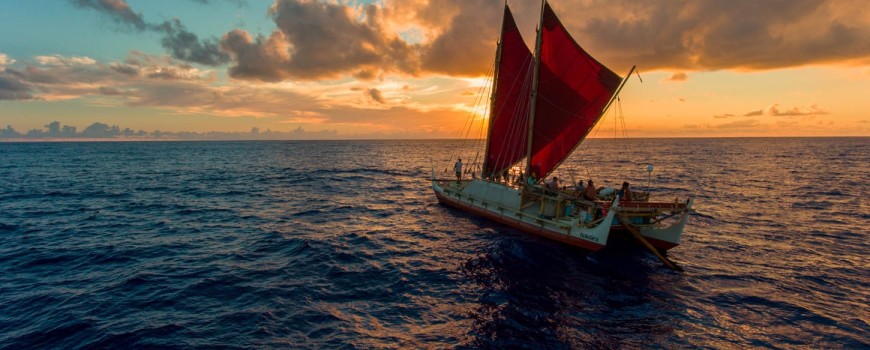
It’s hard to believe that there are only a handful of legs left before our Mama canoe Hōkūleʻa returns home. After sailing for nearly three years on the international portion of the Worldwide Voyage, the Mālama Honua movement has become something that has touched farther shores that some of us even imagined possible when we set out of Hilo, Hawaiʻi in May of 2014. When thinking about the enormity of the impact or influence of this voyage, I would argue that some of the biggest growth and impact has actually occurred right here, on the deck of a sailing canoe, as she has traversed all these miles across the blue face of the planet.

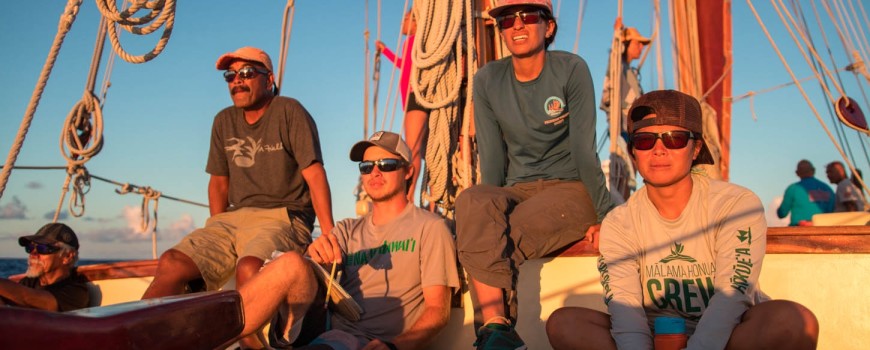
Take this navigation team for Leg 28 – they are a living, breathing, growing, and still-evolving example of the impact and influence of the Voyage. All four of them were on the first leg to Tahiti in 2014 as apprentice navigators; and now, together, they are leading the sailing of this canoe in search of the most isolated island on the planet.

If you listen to the early interviews we did with these individuals before the Hilo departure, you wouldn’t even recognize them as the same people — they have grown up on this voyage. The versions of them we have on board today are poised, confident, and rising to the challenge of the complexity and difficulty of the call they have chosen to answer. And in the opinion of someone who has been watching this process intently for a few years now, they are finally ready to learn. Yes, I said learn.

To be sure, they have all had to learn a tremendous amount of “stuff” to be in the position they are on the deck of the canoe. But once here, they have to put all that stuff into practice, to internalize the process of wayfinding unto themselves, the way their teachers did for all the decades before them — and for all the hundreds and thousands of years that our ancestors did before us.

Over the course of the last 17 days and almost 2000 miles they were tested. The simple act of staying awake becomes a monumental test when faced with the responsibility of tracking direction, speed and distance in a manner that can only be done through first-hand observation. Beyond just that sheer physical demand to stay awake, the hardest challenge I witnessed and felt was probably the test of patience. With nerves of steel, our navigators searched the horizon for three days, looking first for that reef and then Rapa Nui, waiting for something to reveal itself.

And then it happened – the elusive, isolated Rapa Nui revealed itself yesterday at about 4 pm. Upon checking, we found we were 43 miles out when the team sighted the island. Some hugged, some sat in a state of almost-disbelief, and one other capped off 42-years of sailing this canoe by personally closing the Triangle. Everyone felt something in their naʻau, something that marked significance for themselves and for the Voyage.

That is the last lesson of this experience. I would argue that activating and listening to your naʻau is the ultimate teaching and learning. Without the birds and swell and clouds as clues we would have never found this place – but our navigators needed to trust their naʻau in order to interpret the signs and follow them. Trusting your naʻau is every bit as important as the math and science behind all of this.

This will be my last “regular” update for this voyage. There are a couple more blogs that I want to post while in Rapa Nui, but this is the last one from the deck of this canoe for a while. Before I go, I would like everyone who reads this to congratulate the crew who just stared impossible in the face and conquered it. And I would also like everyone to share a special acknowledgement to those who took up the task of the navigation; to Lehua Kamalu, Haunani Kane, Jason Patterson and Noe Kamalu – I can’t wait to see what you do next.

From the deck of the Mama canoe, Hōkūleʻa,

Me ka haʻahaʻa
Nāʻālehu for the leg 28 crew


Homecoming__-_Save_the_Date_-_Banner

Hōkūle‘a Homecoming – Save the Date

Sign up for updates and be the first to know as we continue to detail homecoming festivities during the week of Hōkūleʻa’s homecoming
on June 17, 2017!
My Hawaii Story Contest

[REMINDER: Deadline Approaching! Submit your entries by March 10 – link below]

Announcing the 2017 My Hawaii Story Contest!

The 2017 My Hawai‘i creative writing contest is open to all middle school students (6-8th grade) in the state. Students are invited to submit their best story or poem that addresses this year’s theme, ”He Wa’a, He Moku – Mālama Honua: Caring for Our Island Earth” to align with the 2017 Hawai‘i Conservation Conference theme.

“He waʻa he moku, he moku he waʻa”, translates simply as “the canoe is an island, and the island is a canoe.” The Conference theme highlights the need to treat the resources of our island home, and island earth, as carefully as we would the limited water and food carried on a waʻa.

Entries should tell a story, not simply share information. Acrostic poems will not be accepted.

* All middle school students in Hawai‘i are eligible.

* Only one entry per student will be accepted.

* All entries must be submitted electronically. (No mailed entries will be accepted.)

Entries are due by 5:00pm on Friday, March 10, 2017.

For more information go to:
http://www.hawaiiconservation.org/my-hawaii/my-hawaii-story-project-2017


Homecoming__-_Save_the_Date_-_Banner

Hōkūle‘a Homecoming – Save the Date

Sign up for updates and be the first to know as we continue to detail homecoming festivities during the week of Hōkūleʻa’s homecoming
on June 17, 2017!
Continue Reading

Rapa Nui Arrival

The crew of Hōkūleʻa arrived safely at Rapa Nui today after sailing for about 16 days across approximately 1,900 nautical miles of deep ocean. A team of four apprentice navigators successfully lead Hōkūleʻa and the major navigational challenge of spotting the tiny remote island of Rapa Nui (Easter Island) yesterday at sunset. The crew spotted the island about 43 nautical miles out.

IMG_5604“Finding Rapa Nui was by far one of the biggest challenges our crew has faced,” said Hōkūleʻa captain, Archie Kalepa. “With a few more months left in this journey, we’re glad to be back in Polynesian waters and for the opportunity to reconnect with the Rapa Nui community.”

This is the first time Hōkūleʻa has visited the UNESCO World Heritage Site since her last voyage to the island 18 years ago. The Rapa Nui arrival also marks the voyaging canoe’s return to the Polynesian triangle since departing these waters three years ago on the Mālama Honua Worldwide Voyage.

The team of apprentice navigators have been working together on navigating and turning studies into practice since departing the Galapagos Islands on February 12, 2017. They have been guiding the way by using their knowledge of the stars and taking directional cues derived from their observations of nature. Because of its tiny size and remote location, Rapa Nui is considered one of the most difficult islands to find using traditional wayfinding.

After making landfall in Rapa Nui, the crew will be joined by a teacher and student delegation from Hawaiʻi and the group will spend the week participating in cultural and educational engagements with Rapa Nui leaders and the community. Activities will include meeting both the Governor and Mayor of Rapa Nui, a visit to the kupuna (elders) of Hare Koa Tiare Care Home, and a tour of Museo Rapa Nui. The crew and delegation will also connect with the Toki School of Music for a day of community service and voyaging outreach.

With famed archaeological sites including nearly 900 monumental statues called moai and an isolated environment rich with unique diversity, the small volcanic island of Rapa Nui represents an opportunity for the crew to learn more about the island’s status as a World Heritage Site as well as the strong cultural history of its Polynesian ancestors.


Homecoming - Save the Date - Banner Feb 17 Update

Hōkūle‘a Homecoming – Save the Date

Sign up for updates and be the first to know as we continue to detail homecoming festivities during the week of Hōkūleʻa’s homecoming
in June 2017!

Hōkūleʻa Update | February 25, 2017

Blog by Nāʻālehu Anthony

Patience

According to the navigation team, this will be our last full 24-cycle on the canoe. Since last writing, we have been steadily searching for clues that land is nearby. While the clues have been plentiful, any actual land has proven elusive. The reef and rock we thought that we would have seen yesterday did not appear. The navigation team went back to the same two simple questions- 1) Are we east, or west, of the target, and 2) are we at the right latitude? Something must not be right if we did not see the reef. Dead reckoning tells us that we are east of the target and slowly heading west. By midday today it became clear that we had travelled enough miles west to see the reef, but we did not; so then our latitude came in question. The team met and talked about the possibilities; they felt that we must be too far north for either the reef or Rapa Nui. Based on that conversation, we cautiously turned down a house (11.25 degrees) to still head west but with a bit of south built in.

We’re in the late night darkness now. We know that we have passed the reef that was our first sighting target, so the only target left for us is Rapa Nui. To sight it, even in clear weather we would have to pass within a 30-mile radius of it. Even so – we anticipate landfall soon.

On this night in the early hours, the energy is different then it has been for the last two weeks on board. There is of course anticipation of landfall. But I think the crew has also begun to savor these last moments on board the canoe before it comes to an end. Some know that this will be their last time on board the canoe for the rest of the Worldwide Voyage. And although a handful of us may get to sail on subsequent legs, we all know that the very special experience of this Leg will never be replicated again.

And so we make our way on our course, just a little south of west, looking to pull land from the sea.

We’ll keep you all posted as we go.

Aloha nui,

Nāʻālehu and the Leg 28 Crew


Homecoming__-_Save_the_Date_-_Banner

Hōkūle‘a Homecoming – Save the Date

Sign up for updates and be the first to know as we continue to detail homecoming festivities during the week of Hōkūleʻa’s homecoming
on June 17, 2017!

Hōkūleʻa Update | February 24, 2017

Blog by Nāʻālehu Anthony

Aloha nui kākou,

Big day today.
We caught a pretty big ʻono this morning. It fed the crew for 3 meals, and there’s still some left for the midnight snack. Russell caught it in the early morning after having the lines in the water for about 2 minutes. Needless to say, catching this fish brings our average way up from where it’s been so far on this leg. Maybe we’ll be lucky enough to catch more fish as we get closer to land.
But perhaps bigger than that news, today we turned west along what we think is about 26.30o south latitude. Our calculations say we are within about 200-300 miles of Rapa Nui, and we have begun the search for it – please continue reading below for a description of the search for the island.

Aloha nui,
Nāʻālehu

——-

The Search

We know we are close. We knew that this would be the hard part. As much work as it has been to get the canoe back here into the Pacific, these last few days on the cusp of entering the triangle will be the hardest part. We are looking for two targets – the first is an uninhabited reef system and set of rocks that are roughly 200 miles to the east of Rapa Nui and a little north. We were hoping to see the reef this evening, but that did not happen. Another way for us to find that first target is a light on one of those rocks that pulses every 12 seconds, which we are hoping to see tonight. The second target is Rapa Nui itself, which anchors the southeast corner of the Polynesian Triangle. This island is one of the smaller stand-alone targets in a vast region of otherwise empty sea.

The ability to find this island means that the navigation has to be more precise than usual. To illustrate this point, let me explain a larger target. If we were sailing to Hawaiʻi, for example, we would be looking for Mauna Kea, which at well over 10,000 feet high, stops clouds and creates weather patterns that can be seen for hundreds of miles. Also, the latitude band that spans from South point on Hawaiʻi Island to Kauaʻi is 18.9o to 22.5o North latitude, a band of roughly 3.5 degrees. Each degree is equivalent to about 60 miles; you get the idea that you have hundreds of miles of potential in which to find the islands of Hawaiʻi If you can sail into that band with confidence, there is almost no way to sail through the island chain without seeing an island.

We are fairly certain that our current location is within the latitude of 26o to 27o south – and so we made the turn, and now begin the search. The target of Rapa Nui is about the same size as Kahoʻolawe and not even 2000 feet tall. Its viewing distance is a 30-mile radius or a 60-mile diameter. This means that we have to sail by it within 30 miles in order to see it, and as I mentioned before, in the navigation world in which we practice, one degree is a very tight tolerance. If our timing is wrong and we enter into the 30-mile limit at night, there is a chance we would go right by it and not know.

Yet the mood on board right now is light and happy. As a collective led by a team of young navigators, this crew has put us in a great position to see success. Seeing land come from the sea never gets old or boring, every time I have been witness to this process it has been a deeply humbling experience. Humbling that those who came before us did this with stone-aged tools and developed the technologies to figure it all out, well before the Western world dared to leave the sight of land. And so, for what we think is a just a little bit longer, we wait and we work reach our goal and bring forward with us the brilliance of our ancestors.

Patiently standing by 72,
Nāʻālehu


Homecoming__-_Save_the_Date_-_Banner

Hōkūle‘a Homecoming – Save the Date

Sign up for updates and be the first to know as we continue to detail homecoming festivities during the week of Hōkūleʻa’s homecoming
on June 17, 2017!

Hōkūleʻa Update | The Turn

Blog by Nāʻālehu Anthony

The big question of this leg of the journey?

“When do we turn?”

If you’ve been following our course over the last couple of weeks, you would have seen that we are sailing roughly Nālani Kona (southwest by south), in a pretty straight line. This long line is the first critical step in the process of getting to Rapa Nui. The sail plan for this leg was designed to head generally Nālani Kona until we hit the latitude of Rapa Nui (27o South); at which time we would “make the turn” and head West along that latitude to find the island.

To find an island, we need to know two very important things.

1) Are we East or West of the target? That is – when we reach our target latitude, will we turn to the East or West to find the island?

2) How do we know we have reached our target latitude?

If we have sailed our line with precision, we will know 1) that we are East of Rapa Nui, and 2) that we are at 27o South. In this case, we have kept a line that is far to the East of Rapa Nui so that we are virtually guaranteed that we are to the East when we get to the latitude we seek.

So now we have to answer – how will we know we are at the same latitude of Rapa Nui? There are two ancient tools our navigators use to determine latitude. The first is called dead reckoning – how far did we go, for how long, and in what direction? The navigation team counts up all the miles every day and the direction those miles were traveled in and, after a couple of weeks, you calculate that you have traveled enough miles to get you to the latitude of Rapa Nui (I’m over-simplifying, but you get the idea).

This basic calculation method has all kinds of variability built into it. You get nights where wind slows down and speeds up, making accurate mileage calculations difficult. Squalls come through and you have to close the sails, again changing speeds and therefore miles earned. Sometimes we have to wait for the escort boat or have other reasons to slow down, which again changes speed. All of these variables have to be accounted for and factored into the calculation of where we are as we travel south. After a few weeks, the miles really start to rack up – and with them, the instances where we experience variability, and therefore some of the doubt about our actual latitude.

Lucky for us, we have a second method – we can also tell our latitude by the stars. The navigation team waits patiently in the dark of the night as stars rise and set, looking for the stars they know they can measure, estimating their height above the horizon at their highest point in their arc across the sky to determine latitude. Over the course of the last two weeks, we have gotten clear enough nights even just the handful of times needed to help check our latitude in the stars against the dead reckoning that our navigators tracked all these days. As of sunset last night, we were estimated at 23.45o South. So, we have just a few more degrees to go before the navigation team decides to turn West to look for Rapa Nui. Because the target is so small, the decision of “when to turn” is critical to the success of the voyage.

Literally thousands upon thousands of observations and decisions comes down to that one decision. While all the rest of the work had to be done with precision, it’s a pretty cool thing to me to have all the work point to one choice that will bring an island out of the sea after a few weeks (or not). This is just one of many choices that have to be made by these young navigators that challenges and builds confidence in them as they learn this craft. Stay tuned and follow us on the tracking map at Hokulea.com to see where we make The Turn.

SB 72,
Nāʻālehu


Homecoming__-_Save_the_Date_-_Banner

Hōkūle‘a Homecoming – Save the Date

Sign up for updates and be the first to know as we continue to detail homecoming festivities during the week of Hōkūleʻa’s homecoming
on June 17, 2017!

Crew Blog | Dr. Boranian: Connecting Functional Medicine to Mālama Honua

Blog by Dr. Dickran Boranian

Aloha,

As the medical officer on board Hōkūleʻa for Leg 28 from the Galapagos to Rapa Nui, I have been presented this incredible opportunity to reflect on the mission of the Worldwide Voyage, and how it also ties into my field and practice. Our captain, Archie Kalepa, has taught us that honua can have multiple meanings. Honua can refer to our planet, our community, our family, or ourselves. So Mālama Honua literally means to take care of our planet, our community, our family, or ourselves. One important part of the mission to mālama honua is to raise awareness of man’s effect on the health of our planet, and by doing so engage people in ways to care for our mother earth.

Over the last several years I have been studying Functional Medicine. If I were to define Functional Medicine in one sentence, I would say that Functional Medicine is the science of creating health. Functional Medicine uses systems biology to uncover the underlying cause of disease, through a mutually-beneficial therapeutic relationship between patient and practitioner that acknowledges the unique nature of each individual. The ultimate goal is to restore vitality to the patient – this is much more than simply the absence of disease. Restoring vitality requires supplying that which is lacking, and removing that which is in excess, bringing a new sense of balance to the system that facilitates vibrant health.

Most of our modern diseases are created by poor lifestyle choices. By making better dietary choices, becoming more physically active, using simple stress reduction techniques, reconnecting to our communities, supplying that which is lacking and removing excesses most of these diseases can be reversed. In much the same way the health of our planet can be addressed. We must supply that which is lacking and remove that which is in excess to help restore a vital balance to our environment.

Simply put – by adopting healthy global lifestyle choices we can address planetary health.

It is not too late and we all can make a difference. What we need to do is raise our consciousness concerning how our daily actions affect the health of our environment, and then make better choices.

If you doubt that you can make a difference I would like you to consider this: We all make powerful decisions and, in a way, vote every day. When you spend your hard-earned money, you are supporting something by voting with your dollars. Do you believe that access to locally-grown, healthy food is important? Then shop for your food at a farmers market, join a food coop, plant your own garden, or subscribe to a Community Supported Agriculture (CSA) group. Do you believe in supporting your local businesses and community? Then put your money into your local credit union. Do you want to support environmentally-conscious companies? Then make sure your investments include those companies.

This voyage with Hokuleʻa has inspired me to be more aware of the effects my everyday decisions have on me, my family, my community, and our Island Earth. We can all Mālama Honua. By caring for ourselves, our family, and our community in a more conscious manner we will go a long way in caring for our planet.

Mahalo,
Doc on the Rock


Homecoming__-_Save_the_Date_-_Banner

Hōkūle‘a Homecoming – Save the Date

Sign up for updates and be the first to know as we continue to detail homecoming festivities during the week of Hōkūleʻa’s homecoming
on June 17, 2017!

Hōkūleʻa Update | February 20, 2017

Aloha nui kākou,

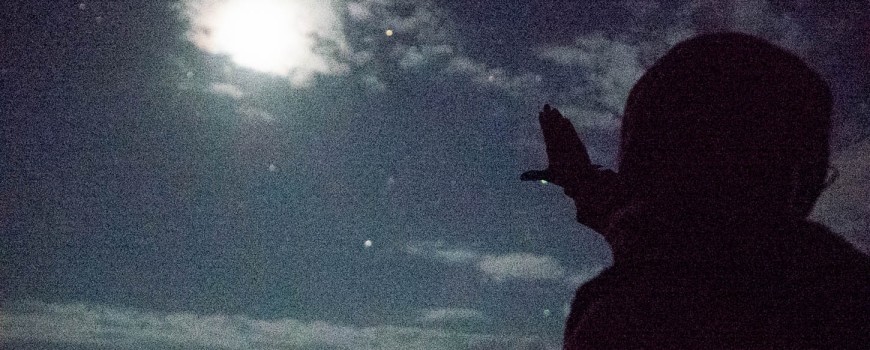
It’s sometime before sunrise. We’re heading southwest, as we have been for days now. The canoe has calmed down for the night. Most of the crew is asleep; on deck it’s just our watch, captain Archie, and our navigators, Lehua and Noe. Their directions come in quiet asks as we sail along, with the steering sweep in the water for light touches to keep our direction true. The navigation tonight is textbook – we have every star we could want in the completely open canopy above. I would argue that it might actually be too dark tonight, as some of our more famous guardians overhead are met with competition of other stars that usually aren’t seen this easily. There is a quarter moon rising near Maui’s fishhook that washes out the immediate area. But even a waning Mahina the moon is still bright enough to cast shadows on the deck of our ancient craft. The wind has pulled back some, giving us a more comfortable rhythm and a much welcomed respite from the cold bite of the wind. Still, we are all bundled up with at least two layers and jackets and pants.

Nights like this are unbelievable for most of us city slickers. Our senses are dulled by the light pollution back at home, and scenes like this seem more like fiction than real life. Even in Kaʻaʻawa where I live on Oʻahu, the stars don’t come out this bright. And so, in awe, we sail through this patch of open ocean guided by these friends in the open sky to show us the way. We keep the mast just to the right of the Southern Cross, the Dipper behind us near our starboard quarter, and the Hook lingering just off our port beam ever so slowly rising lazily on one side.

I have often wished for a way to show all of this – or even just keep a memory of it for myself – but our technology just couldn’t compare to what we experienced in reality. For those of you who have been following us for a while, you might remember my blogs during the Indian Ocean crossing which included descriptions of the night scenes as well. I think at one point I actually wrote that I wished you all could see what we are seeing, but that the camera we use didn’t have the ability to capture what we were seeing. I’m excited to announce that we’re testing out a new-ish camera on the canoe and it has the ability to shoot in very low light. We put it on board in Miami and have gotten a chance to shoot some pretty amazing images in the dark night. We see it as another tool to be able to bring our audience that much closer to being with us on the canoe. Last night was one of the best of the trip, and I think we captured some of that through the lens. I hope you enjoy the images. Stay tuned as we share more from the deck of Hōkūleʻa on this Leg 28 of the Voyage.

SB 72,
Nāʻālehu


Homecoming__-_Save_the_Date_-_Banner

Hōkūle‘a Homecoming – Save the Date

Sign up for updates and be the first to know as we continue to detail homecoming festivities during the week of Hōkūleʻa’s homecoming
on June 17, 2017!