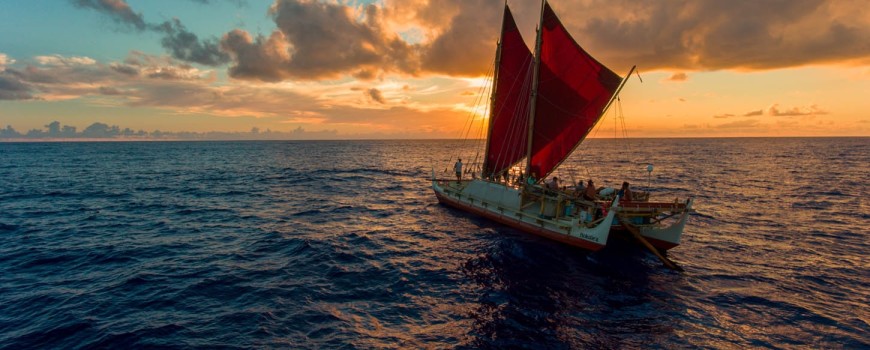
Promise to PaeʻĀina PRiMO Events on March 22nd

Members of the Promise to PaeʻĀina o Hawaiʻi and the Polynesian Voyaging Society will be involved at this yearʻs Pacific Risk Management ʻOhana (PRiMO) Conference in Honolulu! Join us for a free community event in the afternoon or a pre-registered event in the morning.

If you are a registered participant for the conference, we invite you to a Talk Story session tomorrow, Wednesday, March 22nd 10:30am – 12:00pm at the Hawaiʻi Convention Center. Event flyer at the bottom of post.

Later that day, the Polynesian Voyaging Society will be hosting an exhibit and merchandise booth as part of the “Hawaiʻi Prepares 2017” Free Community Night, 3:30pm – 7:00pm in the main plenary room of the Hawaiʻi Convention Center.
All are invited to this free and fun family-friendly event. Learn more about the Mālama Honua Worldwide Voyage and what we have planned for the historic Homecoming of Hawaiʻiʻs treasured iconic canoe, the Hōkūleʻa. See flyer below for more information and list of free sessions. Admission and Parking for this part of the conference is FREE!

PRiMO CommunityNightFlyer_March 22 copy

See below for flyer about the 10:30 am to noon event for pre-registered attendees.
P2P PRiMO Event Flyer_03.22.17 FINAL copy

Homecoming__-_Save_the_Date_-_Banner

Hōkūle‘a Homecoming – Save the Date

Sign up for updates and be the first to know as we continue to detail homecoming festivities during the week of Hōkūleʻa’s homecoming
on June 17, 2017!

Hōkūleʻa Mo‘olelo: The Pwo Ceremony

sam_lowExactly ten years ago, on March 17th, 2007, Pius Mau Piailug held a ceremony to initiate 16 of his students as Pwo – Master Navigators – and realized one of the most important goals in his long and illustrious life – the perpetuation of the ancient art of wayfinding passed down to him by his ancestors.

We celebrate that moment with this description of it by Hōkūle‘a crewmember and documenter, Sam Low, who was privileged to attend the ceremony on Mau’s home island of Satawal.


Hokulea Moolelo GraphicThe Pwo Ceremony

The island was tiny. As we sailed around its southern shore, the aroma of land reached us. We saw a line of lofty canoe houses and a crowd on the beach. Their singing – soft, undulating – blended with the wind.

It was March 15th, 2007 and I was aboard Hōkūle‘a as we made landfall on Satawal, Mau Piailug’s home island. This voyage began fifty-one days ago when Hōkūle‘a set off from Hawai‘i, accompanied by another voyaging canoe – Alingano Maisu – a similar double-hulled vessel that had been built as a gift for Mau.

A conch shell was blown on the island and small boats came out to assist with placing our anchors. The sun, low on the horizon, glowed in surf breaking on the reef. We had finally arrived at the place where the revival of the ancient art of navigation, led by Mau, had begun.

*****

Mau sailed aboard Hōkūle‘a on her first two successful voyages from Hawaii to Tahiti. From 1985 to 1987, he voyaged on various legs of her next mission – a two year, 16,000 mile retracing of almost all the traditional voyaging routes – that inspired a revival of seafaring culture throughout Polynesia.

Hōkūle‘a’s voyages stimulated others to build large traditional canoes. In 1992, Hekenukumai Busby, a New Zealand Maori elder, constructed Te Aurere, a large voyaging canoe of his own. In 1993, Hawai’iloa was launched on O‘ahu with support from the Polynesian Voyaging Society and in 1995, Shorty Bertelmann and his brother Clay launched yet another canoe, Makali‘i, on the Big Island of Hawai‘i. In that same period, Tahiti Nui was built on the island of Tahiti and Takitumu and Te ‘Au o Tonga were built on Rarotonga. In 1995, all of these canoes set off from the Marquesan Island of Nuku Hiva bound for Hawai‘i, the first time in a thousand years that a fleet of Polynesian sailing canoes had journeyed together. All arrived safely and made their way back to their home islands again, guided by navigators trained by Mau Piailug with the assistance of Nainoa Thompson.

All these voyages, and Mau’s mentorship of native Polynesian navigators, stimulated not only the building and sailing of canoes, but the revival of Polynesian culture in general. Among Hawaiians, where the loss of culture had been particularly severe, hālau hula (hula schools) seemed to spring up everywhere, heiau were rebuilt, ancient curing practices were revived and, in 1999, the first class of high school students graduated having spoken only Hawaiian from their entry into the first grade. Reinvigorated Hawaiians stood up to demand the return of lands taken from them illegally. In 1995, President Clinton signed the Apology Decree – validating their claims – and today, many Hawaiians are working to regain their sovereignty as a native people.

In 1999, Mau carried out the most significant step in his plan to revive his own traditions by sailing aboard the Hawaiian canoe, Makali‘i, to his home waters, making landfall on many of the major islands in the Federated Sates of Micronesia. In 2001, Mau returned to Hawai‘i to begin building Alingano Maisu – a gift to him from Shorty and Clay Bertelmann and many others for all that he had done for Hawaiians.

Now, in 2007, as Hōkūle‘a and Maisu anchored off Satawal, Mau was 75 years old and suffering from a life-threatening kidney ailment. It was time, he thought, to bring together his entire voyaging family for an ancient initiation ceremony – pwo – that was last performed on Satawal fifty-six years ago.

Eleven men from Satawal had studied sufficiently to earn the privilege of being initiated as pwo navigators; Selestine Retewailam, Andrew Igomal, Isidore Metewalur, Romanes Yarofaichiy, Lorenzo Sartilug, Manno Ratilou, Alfonso Reilug, Luke Yauritik, Camilo Eraegmai, John Lalogo and Mau’s son, Sesario Sewralur. In addition, five men from Hawai‘i would be initiated – Nainoa Thompson, Shorty Bertelmann, Chad Paishon, Chad Baybayan and Bruce Blankenfeld.

******

On the day of the pwo ceremony, March 17th, outrigger canoes were drawn up on Satawal’s sheltered shore beneath lofty canoe houses, their thatch roofs glistening in the sun and their floors covered with fresh woven mats.

The ceremony began early in the morning when men arrived with firewood – led by one of the island’s initiated navigators. They laid the wood in a small grove of coconut palms where other men prepared breadfruit for baking. The village was filled with song from women working about a hundred yards away, preparing taro.

The men dug an earth oven and kindled the sacred firewood. The initiated navigator placed two kinds of coral in the fire to convey sacred powers. Hard coral signified the mental and physical toughness of the navigator and stinging coral symbolized the strength of the navigator’s command at sea.

Joining Mau for the ceremony was an initiated navigator from the nearby island of Pulap, Lambert Lokopwe. “They wait until the fire is red hot,” Lambert explained, “Then they put the coral on top of the fire. When the breadfruit is cooked, the men start pounding it. The women are pounding sweet taro. When both are complete, the women put it in the uulong – a special calabash. Then they cover it up and see that the uulong faces the Big Bird – raising Mailap, east – and it stays overnight for the final ceremony the next day.“

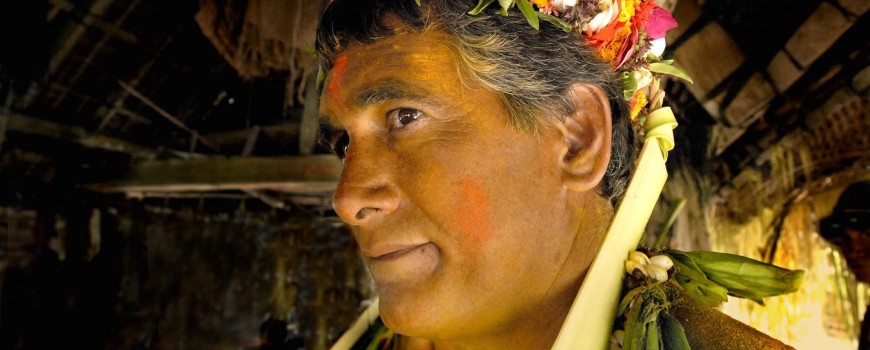
During the early morning on Sunday, the day of the pwo ceremony, the wind died and shifted easterly, casting the anchorage in a lee. The ocean was deep blue offshore and emerald in the tiny lagoon. The sixteen navigators, powdered with yellow turmeric, dressed in red loin cloths and garlanded with headbands of colorful flowers sat patiently in the canoe house. Around their necks was a lei of ginger leaves – yoangerhik – a medicinal plant.

The women gathered outside and sang rhythmically. At about ten AM, Mau was helped to a white plastic seat cushioned by blankets and woven mats. One by one, the men crawled to him and he rubbed them with a sacred medicine, first on the forehead, then on the heart, chanting as he blessed each pwo navigator. “The medicines are given to the heart and to the mind for the navigator to have seram – light,” Lambert says, “so he voyages with the light, never darkness.”

Next, Mau touched each navigator on the shoulder with a long strand of coconut fiber which he then parted and placed over their heads as a garland. Mau’s face was somber, reflecting the power of this blessing. The incoming navigators were then given a special coconut to drink – nuun-lesseram or “coconut in the light.” “The coconut will give light to the new navigator,” Lambert said, “but the deeper meaning is perseverance, confidence in yourself as a new master navigator. That coconut is a large one. Each navigator drinks it and never stops until it is completely gone, meaning that he has full confidence in himself – that he will pursue the course until it is finished.”

The sacred calabash – the uulong – was then covered with woven mats. Two gods – Luukeileng, the center of heaven, the god that controls everything; and Weriyeng, the god of navigation, owned the calabash. During the final rites, Mau instructed each incoming pwo, one by one, to place their right hand on the covered uulong while he prayed to the two gods to bestow pwo upon him.

Each new pwo was then given a bracelet that contained the stinging coral representing the power of the navigator’s words and the hard coral conveying his toughness in the face of adversity. Tied to the bundle were feathers of the Big Bird. “Mau is calling upon Luukeileng and Weriyeng to bestow all rights, everything concerning navigation, on this person,” Lambert explained. Finally, the food from the sacred calabash was divided and eaten by all the initiated navigators.

A year later, in March of 2008, Mau presided over one last pwo ceremony for Maori navigator Hekenukumai Busby, the builder of Te Aurere. On July 12, 2010, Mau passed away on Satawal.

All his life, Mau had struggled to spread the knowledge he inherited from his ancestors. Almost single-handedly he reversed two centuries of cultural decline among Hawaiians, replacing it with a resurgent pride in their great seafaring heritage. Today, Alingano Maisu sails among the Caroline Islands, captained by his son, Sesario Sewralur, to carry on Mau’s mission of reviving his own seafaring culture. And throughout the vast Pacific, canoes are being built and sailed by a revived nation of seafarers. The seram – the powerful light – that Mau Piailug first carried to Hawai‘i in 1973, will forever inspire the people of the Pacific and beyond to raise islands from the sea.


The above moʻolelo was adapted by Hōkūleʻa crewmember and documenter Sam Low from his book – Hawaiki Rising, Hokule’a, Nainoa Thompson and the Hawaiian Renaissance.

Hōkūleʻa Update | March 13, 2017

Blog by Heidi Kai Guth

Early in the day, our navigator, Kaleo, says we are a quarter of the way to Pitcairn. Everyone seems a little lighter in spirit and more comfortable at the start of our third full day at sea. People are grooving into their rhythms and blending with their watches and each other better and better.

Today, after our 6 to 10 morning watch, Kekama brings out his ʻukulele, Keoni finds a fat Hawaiian song book, and crew members begin to sing and occasionally break into dance. Some crew members are hiding in the shade, reading, and the 10 to 2 watch steers in the high, hot sun. ʻAina films the joy, until we all begin to notice a series of squalls sneaking up on us. The concert is interrupted because of sail change needs and rain, with captain Russell and sail master Bruce leading the way.

Most of the squalls are short and mellow, but one dumps wind and rain straight down on us, while Bruce takes the time to explain to us why and how the squalls are different and what to look for in anticipation. Crew dash about, enjoying the fresh water rinse for clothes and bodies, while sails are changed again and again to meet the changing patterns of the wind. Near the end of the 2 to 6 watch, a huge rainbow frames the rotating steersmen from behind, as the sun breaks through the clouds and gets ready to set in front of us. We have had a rainbow or double rainbow every day so far!

We are operating on waʻa time — all of our watches have been put away, and any cameras or phones used as cameras have been set to completely random times. We are not using any human-made timezones, but letting nature tell us what time it is and when crew watches change. For us, the sun always rises 6am and always sets at 6pm. Our navigator tells us by the angle and position of the sun when it is 10am and 2pm (crew change times). He is teaching us how to use the positions of stars and constellations to know when our crew change times are at night as well. Thus, we all feel like we are participating a little in the navigation. We all learn more each shift about which stars to use to steer by; how the sun, moon, planets and stars move across the sky during our watches and how to adjust our steering to those movements; when to huli our crews for the next watch; how the moon rises about 52 minutes later each night; how Jupiter is bright enough to use during our recent full moons until Hikianalia rises high enough to see; etc.

Everything is stripped down to the essentials that nature requires, and we are all happily aware of and learning more and more how to respond to the cues that nature provides and the needs of crew and canoe: keeping clean, well fed and hydrated, and taking the time to make each other happy by looking out for each other and the collective well being of our voyage.

Voyaging, among many other things, is an adventure with like-minded people away from known comforts and distractions. A voyage gives each of us a chance to be our best selves. It might be an opportunity to rediscover who that best person is, or to decide or evolve who we want that best person to be. The larger goal is to not only accomplish that at sea for our crew mates and canoe, but also how to continue to carry our best selves forward once we reach land and once we return home. Vigilance is required to not get tricked back into the seemingly more limited expectations of many land-based societies and the conventional norms we may have grown too comfortable within prior to the voyage.

Here’s to each of us, whether on land or sea, finding our rhythms within our best selves so that we can navigate together — with nature — toward a brighter, more balanced future based on the wisdom of indigenous cultures who built such glorious voyaging canoes and the skills to sail them purposefully.


Homecoming - Save the Date - Banner Feb 17 Update

Hōkūle‘a Homecoming – Save the Date

Sign up for updates and be the first to know as we continue to detail homecoming festivities during the week of Hōkūleʻa’s homecoming
in June 2017!

Crew Blog| Austin Kino: Living Faces of Our Ancestors

Austin_KinoBlog by Austin Kino

“When you look at the Moai be reminded that you are the living faces of your ancestors” – Julianna Rapu

As I sit in my bunk in Starboard 2 and glance across the deck of Hōkūleʻa I am eye level with two new faces to our Leg 29 crew. Hinariru and Mahorangi are the two scale model Moai that were carved as gifts for our crew and have found their way aboard our Wa’a as we travel from Rapa Nui to the island of Pitcairin.

It was only a couple of days ago that I stood staring up at the full scale Moai as our crew visited Rano Raraku, the only quarry on Rapa Nui, which is where every Moai on the island was born. Being amongst these massive creations after years of seeing images of them in school only reinforced the mystery of their existence. Standing upon the hill with some still-unfinished thirty foot tall Moai carved into the hillside beside us, our tour guide, Hangarau Ote Ariki, shares with the crew that even he still wonders how his kupuna managed to transport their masterpieces across the island.

Archaeologists believe that between the 15th and 17th century the 9 tribes of Rapa commissioned a total of 723 Moai to be built. Hangarau looks at the Moai as the faces of his ancestors who still to this day bring him and his family protection even as they travel away from Rapa Nui. He shares that it was the occupation of one tribe who lived in the village of Tongariki that neighbors the quarry to construct the Moai in exchange for food and supplies from the various tribes who at one point exhausted their resources in this effort to honor their Aliʻi. It is said that it would take an average of 30 laborers a year and a half to carve a single Moai spending over 6 months on the face alone.

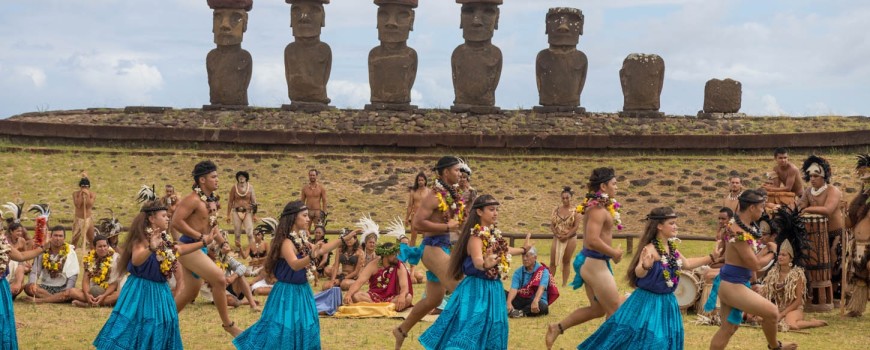
On our final night in Rapa Nui after touring the island and visiting as many Moai as the day would allow our crew was invited to attend the local Rapa Nui dance performance known as Kari Kari. Watching the moves of the dancers it was easy to identify the similar dance traits of neighboring Polynesian styles. A few crew members were selected to come up on stage for the always entertaining rendition of the Tamure where the men bend their knees low and in the rhythm of the fast Tahitian style drums need to keep up with the beat moving the knees quickly together and apart while trying to mirror the hand motions of the female dancer.

After much laughter and entertainment our crew was asked to come on stage following the final number to be given a stone carved Moai to take back to Hawaiʻi as a reminder that the people of Rapa Nui are always wishing protection over their cousins in Hawaiʻi. As ocean people we understand that we are not separated by oceans but instead connected by them. This notion was evident in the final moments of Hōkūleʻa’s departure when a handful of our hosting friends stayed on board to help us the prepare food and ready Hōkūleʻa for her voyage. In a few quiet conversations between our leadership and this keen group it was evident that the seed for voyaging in Rapa Nui had been planted. Now looking at the carvings outside of my bunk I see the Moai as a reminder of the timelessness of our commitments to preserve our cultural treasures and the truth of the words spoken to us that we are all the living faces of our ancestors.

Special thanks to Hangarau Ote Ariki, the tour guide who volunteered his time to us.


Homecoming - Save the Date - Banner Feb 17 Update

Hōkūle‘a Homecoming – Save the Date

Sign up for updates and be the first to know as we continue to detail homecoming festivities during the week of Hōkūleʻa’s homecoming
in June 2017!

Hōkūleʻa Update | March 12, 2017

Blogs by Duane DeSoto

March 11 – Day 2 of Leg 29

Yesterday was bit hectic do to so many things to prep and finish up before leaving. Broken anchor line, leaky ground wires and the many little details of setting out to sea for 20+ days with out new provisions.

A full day has passed since leaving Rapa Nui and the energy has calmed as we settle into our sailing routines and gather our sea legs. Calm winds have guided us gently west and small swells follow in our aft. Sailing downwind has its challenges and our crew is adapting quickly. What a gift it is to be sailing on Hōkūleʻa.

A full moon tonight will brighten our way and a possible squall or two will bathe the waʻa. May tonights wind blow steadily and the stars shine bright. Aloha nō, Duane.

March 12 – Day 3 of Leg 29

We are far from land today. We are surrounded by blue on our way to Pitcairn. The sun was blazing and the winds were light. Pacific ocean as far as the eye can see, with a few clouds to break up the different shades of blue.

We traveled a steady 3.5 knots most of the day which proved to be not so good for trolling our lewers. No fresh fish compared to our first day catch of 2 mahimahi. Still tons of fresh provisions to make ʻono meals.

Its truly amazing to be at sea isolated from the rest of the world on a waʻa. An adventure lead by navigators and captains. Somehow the restrictions of life have not been able to stop us from voyaging. Believing in our leaders and trusting them with our lives. Yet not thinking twice about it. Holo holo.

Hōkūleʻa glides elegantly through the ocean on a mission of unity, kuleana, and culture. We as crew are privileged to assist her in this successful journey of teaching nā keiki o Hawaiʻi about how special their roots are and that the world is at their fingertips. What are you capable of if a double hulled traditional sailing canoe can navigate the Earth? Aloha nō, Duane.


Homecoming - Save the Date - Banner Feb 17 Update

Hōkūle‘a Homecoming – Save the Date

Sign up for updates and be the first to know as we continue to detail homecoming festivities during the week of Hōkūleʻa’s homecoming
in June 2017!

Hōkūleʻa Moʻolelo: 18 Years Ago Rapa Nui Raised from the Sea

sam_low

LANDFALL – HOKULE’A RAISES RAPA NUI FROM THE SEA.

Eighteen years ago, Hokule’a first visited Rapa Nui on a historic voyage that closed the Polynesian triangle for the Polynesian Voyaging Society. Here is the report filed by crewmember/documenter Sam Low.


Hokulea Moolelo GraphicFriday, October 8th, 1999.

“Garlic Eggs for Breakfast!” Says Terry Hee, carrying the last two dozen eggs past a group of smiling crew members lining the rail. Terry had planned to ration the eggs for another day at least, but now there’s no reason. We have seen land – and the land is definitely Rapa Nui!

Yesterday at sunrise we set our course south-southeast, beginning the first real leg of our zigzag search pattern. Nainoa intended to tack back north at sunset but the wind curved northeast making that impossible. So instead of tacking, he decided to follow the wind around and steer east-southeast. This was a risky strategy. Although the Navigator’s dead reckoning placed us well west of Rapa Nui, what if they were wrong and we were south of it or even to the east? We would sail by the island in the night.

To make matters worse, we had not seen the stars for two nights and our latitude was therefore based on dead reckoning from star sights that were two days old. Without either sun or stars to steer by, the navigators had been relying on an unexpected blessing – a steady swell from the southwest. But had the swell changed direction?

“This wind is a gift to us to go east,” Nainoa explained to us last night. “So I say let’s go. It’s scary, but it’s exciting. If our dead reckoning is good, and I think it is, we should take the chance.”

All last night and on into the morning the winds continued to blow strong from the northeast and Hokule’a responded by speeding east-southeast – 6 to 7 knots at times – slicing through the waves, producing long tendrils of spray from her bow.

Near dawn, Max Yarawamai spotted two holes in the clouds ahead low on the horizon. Born and raised on the low Micronesian atoll of Ulithi, Max’s ability to see islands at great distance is almost legend aboard Hokule’a.

“I looked carefully at the two holes on the horizon,” Max explained later, “checking first the one on the starboard side. I saw nothing there so I switched to the puka on the port. I saw a hard flat surface there and I watched it carefully. Was it an island? The shape didn’t change! It was an island all right. We had found the dot on the ocean.”

“I didn’t expect to see the island this soon,” Nainoa told us later. “But we knew it was near. We were following the wind around – steering more east as time went by – and the wind drew us to the island. That’s a fact – you make of it what you want. In the end all we did was follow the wind, Hokule’a found the land.”

Hokule’a is now tacking toward Rapa Nui which is about 25 miles away, but upwind, so it’s uncertain whether we will make landfall late this afternoon or early tomorrow morning.

Reviewing the Voyage

Chad Baybayan: “You look at the crew on all the voyages and its not just Hawaiians. The entire Hawaiian community is included in the canoe. It’s really Hawaii’s community. The people who sail on board the canoe are a reflection of the community and society that we live in.”

At about 10 AM, local time, a few hours after having seen Rapa Nui ahead off our port bow, Nainoa called us aft to share some thoughts about the voyage. Bruce, Chad and Nainoa spoke – here are their words:

Nainoa: “The voyage is pau and this gives me almost an empty feeling. But everyone should be proud of this accomplishment. We have traveled to the last corner of the Polynesian triangle and that achievement is not just ours – it belongs to everyone who has donated a portion of the millions of man hours spent taking care of the canoe over the almost twenty-five years since her creation.

“We worked hard to prepare for this voyage but it was not just academic preparation and physical training that got us here. It was my plan to continue sailing southeast and tack back northeast at sunset – but the wind shifted northeast and if we tacked we would have been going back the way we had come. So instead I decided to follow the wind around and in the morning the island was off our port bow. The wind brought the canoe here. It’s about mana. Hokule’a has latent, quiet, sleeping mana when she is tied up at the pier in Honolulu. But when the canoe is sailed by people with deep values and serious intent the mana comes alive – she takes us to our destination.

“The mana is inside all of us. It’s tied to our ancestry and our heritage. Sometime, in the press of daily life, we neglect it. But when we come aboard this canoe and commit our spirits and souls and lives to a voyage like this one, I think we all feel it. I know I do. This is a very privileged moment for all of us – we have stepped inside that realization of mana on this voyage.

“When we go back to our special island home, we need to remember this moment. Mana comes from caring and commitment and values. We malama our canoe and she takes care of us. When we return to Hawaii we need to remember to malama our islands just as we do this canoe. We need to commit ourselves to the values that give life meaning. This canoe is so special – and our island home is so very special – if we learn to care for our land and our ocean they will also take care of us.

Bruce: “A lot of things have happened on this voyage that gave me chicken skin. The port hull of the canoe is the wahine hull and the starboard hull is the kane hull. The symbolism is that the male and the female forces give us life. The symbolism is that they also balance each other – they help each other survive on the ocean.

“In this crew we have shown a nice respectful balance. We have shown that we all know how to work hard and how to treat each other well and that is one of the most memorable parts of the voyage for me. The work ethic among this crew was fabulous. There was not one negative word. This kind of caring for each other is part of the on-going rediscovery of what voyaging is all about.

“The mana in this canoe comes from all the people in the past who have sailed aboard Hokule’a and cared for her. I think of the literally thousands of people who have come down and given to the canoe when she was in dry dock. I think of Bruno Schmidt in Mangareva who showed up with his truck every morning to take us wherever we needed to go. I think of the people in Tautira and Aotearoa and the Marquesas who did the same. The list is endless. All of this malama – this caring – adds to the mana of the canoe. It is intangible but it is alive and well. We can all feel it. I just want to acknowledge it.

Chad: “What made this voyage so special for me was that I felt so comfortable because I knew I was among people who had earned their spot on the crew. You guys are my heroes because you all showed such dedicated professionalism. I am proud to have sailed with you. Now we have another special journey ahead of us, to return the canoe home to our own special part of the Polynesian triangle, and by doing that we honor not only our ancestors but all those people who have supported us at home.

PROJECT WAYFINDER Educator Training

PROJECT WAYFINDER
Educator Training
Stanford University’s d.school
June 22nd – June 25th, 2017

Aloha:

We are pleased to share information about Project Wayfinder, an education initiative developed by Stanford University’s d.school. Inspired by Polynesian wayfinding, the Project Wayfinder Team is piloting a human-centered design process to help students and educators re-imagine high school education.

​Project Wayfinder is leading their first Educator Training this summer at Stanford University’s d.school from June 22-25.


wayfinderprojectWho: 30-40 high school educators from around the globe. The training is open to high school educators including advisory teachers, administrators, school leaders, and counselors.

What: Administrators and teachers will be immersed in a set of Tools and Resources from Project Wayfinder. This will be an immersive and transformative experience for educators – not just a “how to” – but a sharing of how best to teach their Wayfinder Toolkit with students.

Where: Stanford’s d.school

When: June 22nd – June 25th, 2017 (The program will start the evening of the 22nd and will wrap up late afternoon on the 25th)


Here is the link to the Educator Training Application. This application is due by Friday March 17th, 2017. Decisions will be sent out by the end of March.

If you have any questions about the application process or the educator training, feel free to reach out to ​the Project Wayfinder Educator Training Liaison Sonia Doshi​ directly​ at doshisd@stanford.edu. ​

T​hank you for your interest and support!

P​roject Wayfinder Team


Homecoming__-_Save_the_Date_-_Banner

Hōkūle‘a Homecoming – Save the Date

Sign up for updates and be the first to know as we continue to detail homecoming festivities during the week of Hōkūleʻa’s homecoming
on June 17, 2017!

Continue Reading

OPIHI Citizen Science Project

Are you interested in helping Hawai‘i teachers and students get outside and collect authentic scientific data? 
 

Be a volunteer science assistants to help on an OPIHI field trip!

What is OPIHI? 
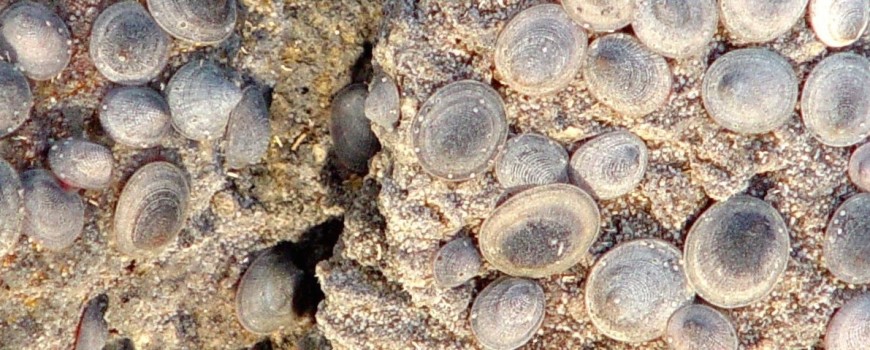
OPIHI (Our Project In Hawai‘i’s Intertidal) is a citizen science project where middle and high school students survey Hawai‘i’s rocky intertidal. The intertidal is the area along the coast that is covered by water at high tide and exposed to air at low tide. OPIHI students gain valuable scientific skills while being involved in an authentic ongoing scientific research project. Some of the intertidal sites students and teachers are going to were surveyed the same way 10 years ago!

How can you help? 
In the next few months teachers statewide will be leading about 50 (!) OPIHI field trips. They would be very grateful for your help keeping their students on task while surveying algae and invertebrates in the intertidal. You do not have to be a marine biologist to be an OPIHI science assistant. It is more important that you are a science enthusiast! 
 
Here is a link to a flyer: https://tinyurl.com/OPIHI-AssistantInfo2017

Why else should you volunteer? 
The intertidal areas are beautiful (you get to be outside for a few hours!) and the students can teach you about a unique, often overlooked environment. Just as importantly, it will be fun! We are happy to provide you with a certificate documenting your volunteer hours on this project if needed. 

How do you sign up to volunteer? 
This is a link to our google doc to see intertidal locations, dates, and times of field trips: 
 

Write your name and email
 in one of the spaces highlighted in yellow on the right of the sheet under “science assistants”. The teacher will contact you a few days before the field trip with additional information (e.g., directions & more specific information on how to help!).
 
Teachers are still finalizing their field trips! Please check back frequently to see if teachers near you have finalized their plans! 
 
OPIHI teachers and students appreciate your interest and we hope you will be able to join us!


Questions on OPIHI? Email Joanna Philippoff at
philippo@hawaii.edu

Continue Reading