Hikianalia Update | March 31 – April 3

Blogs by documentation crew member, Kaipo Kiaha, narrating Hikianalia’s sail south from Hawaiʻi approaching the equator, or ka piko o wākea.

Day 11: Mar 31

We entered the ITCZ, or the Intertropical Convergence Zone, late yesterday and today we felt just some of its unpredictable effects on the weather. The ITCZ, sometimes called the doldrums, is a legendary place among sailors, and after hearing about it for so many years, it is awe inspiring to actually be in it.

Clouds covered us most of the night, but it cleared up for a bit on our 2-6 watch. We raised the Genoa head sail (#34) off the outer head stay this morning in the twilight hours, taking down the Palekai working jib (#16) and our storm jib (#7) in the process. The genoa helped us gain some speed and turn the bow south towards Haka Malanai. By turning south, our goal was to cut down the distance and therefore our time here in the ITCZ.

During the 6-10 watch after the genoa went up, Hikianalia was able to do about 8-10 knots, which is great especially when wind is something you don’t take for granted in the ITCZ. However, after that, wind speed was variable throughout the day, and Hikianalia dropped in speed, ranging from 2-6 knots. We had clouds blanketing the sky and had to use the swells to determine our heading.

Another benefit by turning down a bit was a little bit calmer ride, as the swells were now quartering us off the stern instead of hitting our beam as they have the whole trip down. We took advantage of this by cleaning up the canoe and several of the crew took showers and did their laundry. Lunch was an easy but tasty peanut butter and jelly sandwich.

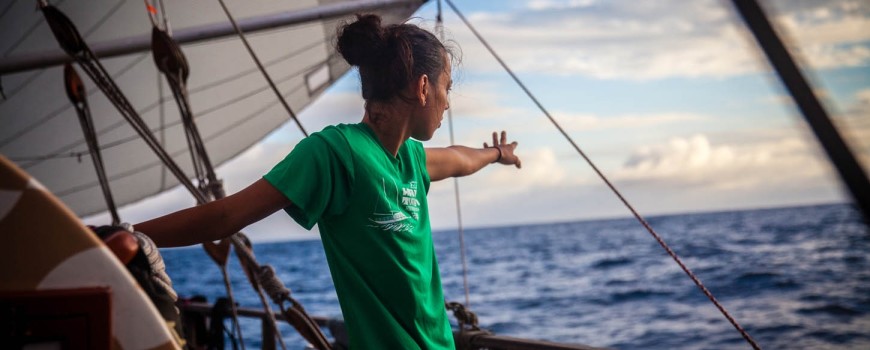
In the early afternoon we changed our head sails again, dropping the Genoa and going back to our Palekai/Storm jib combo. Because the winds were somewhat slack, we decided to go with these sails and take a higher point of sail, going back to our Nālani Malanai course. After our dinner of chicken long rice and cole slaw, we thought we wouldn’t see a sunset because of all the cloud cover. However, the winds picked up just as the sun reached the horizon, clearing out some of the clouds and putting on a spectacular show for our crew, who gathered around for a group photo in the excitement as we all stood there in awe.Nikki Kamalu on the hoe ʻuli in the morning of the 6th day at sea.

No matter how many sunsets you see, no two are the same, and the sight of one never loses its luster. As a hōʻailona for reaching this point of our voyage, we felt blessed to bear witness to this simple yet magical event in the middle of the Pacific ocean.

Our navigation team convened shortly after at dark, as we do every night, and plotted our position on our chart. We estimate we are at 6.5 degrees north and 149 degrees west as of this writing. Longitude wise this puts us just north of Mataiva atoll in the Tuamotu archipelago which is in our target box. If we hold Nālani Malanai we predict another 2 days until we get out of the ITCZ if we average 5 knots, and another 3 days after that until we reach the equator, the next big milestones of our voyage. We are being conservative on our speed predictions as we are not sure if we will continue to keep this good wind we’ve had up until now.

Day 12: April 1

“Kau Ka Lā i ka Lolo”

Today marked our 6th day at sea on our sail down to Tahiti.  It also marked the start of a new month, April. However, perhaps the most significant event of the day was a phenomena known as “kau ka lā i ka lolo,” or the sun is placed overhead. The declination of the sun, or the point where it rises on the horizon, was 5 degrees north today, which just so happened to be the latitude we were at. As the sun moves throughout the year, there are solstices and equinoxes, and its change in position dictate the seasonal changes of weather here on earth.

Simply put, the sun rose and set in a perfect arc, straight up and down, and when it reached its midpoint it was at the zenith, or directly above us.  To commemorate this event, as well as us being in the realm called “Ka Houpou o Kāne,” or the diaphragm of Kāne (aka the doldrums or the ITCZ), we held a modest and simple ʻawa ceremony on the deck of Hikianalia. ʻAwa was made and served with the sun overhead, and most of us sat in quiet reflection, while others engaged in softspoken conversation.  As we near the midpoint of our voyage, it was an important time to reflect on what has transpired and what is yet to come.

It was not a ceremony in the sense that rites and rituals were performed, rather it was just the passing around of the ʻapu, or cup of ʻawa, to each crew member, who then drank from it. Once everyone got a cup, our Captain Kalā Tanaka said a few words, casually remarking on the camaraderie and feeling of ʻohana among our crew. After that, we finished the rest of the kanoa, or bowl, and then went back to the business of the day.  Everyone is getting along splendidly and is happy and healthy and we are making great progress along our course.

Mai ka hoʻokuʻi o Hōkūleʻa, a hiki i ka hoʻokuʻi o ka lā, eia nō mākou.  From the zenith of Hōkūleʻa to the zenith of the sun, here we are.  We are cherishing each moment out at sea and are reflecting on everything we have learned and experienced so that we can share it all with you upon our return.

Day 13: April 2

“Raindrops”

Today was a rainy day. As we exit the ITCZ and near 1 degrees north latitude tonight, we are passing through squall after squall after squall.  We had two periods of decent sunshine which happened to coincide with sunrise and sunset.  This was beneficial for our navigation as we could get an accurate bearing but also it timed well with breakfast and dinner.

During the first pocket of daylight today we caught a short billed sailfish off our port stern fishing line.  Puaita Pulotu set the lure early in the day during the rain and it caught maybe an hour later.  After pulling it in, Uncle Gary Yuen went to work cutting and cooking the fish a few different ways. The head was boiled to make a fish soup, which he used to make a chowder for dinner.  Some of the meat was made into sashimi as well, which we ate at breakfast and dinner time.  He cooked the bone and fried the belly and we ate it with shoyu and wasabi.  Also, the skin was saved and is drying out to make lures, and the Uncle Gary will sand down the bill once it is dry and give it to Puaita as a trophy.

The sunshine didn’t last too long after that as the rain was strong and steady throughout the day.  Luckily there was still some wind and we were able to maintain a speed of about 5 knots along our course of Hema/Haka Malanai.  After the sky cleared around dinner time and we enjoyed the fish chowder, the wind died down and with it our speed, with Hikianalia doing only 2-3 knots on the slow end.  As a Hikina swell picks up our stern and drives the bow up, the big Code Zero sail we are flying off the front luffs loudly but snaps back into place.  Although the wind is light now, the squalls continue to come.  We are expecting similar weather to this for the next few days.

Sometime late tomorrow we estimate we will cross the equator, which is a milestone for myself and a few others on board, Lohiao Paoa and Jackie Meggs.  Soon after that, it is about 15 degrees latitude south to our target block between Mataiva atoll and Rangiroa atoll in the Tuamotu archipelago: a distance of about 900 miles.

It’s hard to believe we have gone this far in little over a week. The crew is happy and healthy and having the time of their lives on board.  We are all getting along well and the morale is high.  We miss our family and friends back home but want everyone to know we are okay and working hard out here at sea.

Day 14: April 3

“Ka Piko o Wākea”

We crossed a milestone today on our voyage from Hawaiʻi to Tahiti. We crossed the equator in the early afternoon today.  In stark contrast to yesterday’s constant downpours, today was sunny and clear all day, and we had steady winds at 10-15 knots.  Hikianalia has held Haka Malanai most of the day at around 5 knots, with a swell out of Hikina and a building ʻĀkau swell as well, but both relatively small around 3-5 feet.  So all in all it made for a gentle and calm crossing into the Southern Hemisphere.

As the sun rose overhead today again, everyone gathered around for a more formal ʻawa

ceremony.  Everyone said a few words after we offered some ʻawa to the waʻa as well as the sea.  Following the ʻawa ceremony we had an offering of wai, where water from Maui was poured into the ocean as a hoʻokupu.  We also offered our lei lāʻī which have followed us from Oʻahu and Hilo.

As the sun got low in the sky we ate our third day box meal of salmon patties and rice.  Jackie Meggs made the patties and they were delicious.  We continued our jarred food items taste test and opened the pickled eggplant, kim chee, and papaya slaw.  The jars containing this preserved foods are meant to keep for long periods of time without refrigeration and detailed notes on taste, appearance, smell, and other factors are taken by a couple of the crew members.

Night was a time to “make happy,” where first time equator crossers myself, Lohiao Paoa and Jackie Meggs entertained the rest of the crew, and we played music into the night hours.  We are steering by the ʻOle moon tonight, ʻOlekūlua, which is significant for a few reasons.  The moon appears as half full, mirroring our own position on the globe. ʻOle, meaning Zero, reminds us we are at zero degrees latitude.  Finally, kūlua, the two halves of the earth we are traversing across, the northern and southern hemispheres.

This place called Ka Piko o Wākea is significant as well for the constellation Wākea, also called Ka Heihei o Nā Keiki or Orion, for Mintaka, his piko, one of the three “belt” stars, has a declination of zero degrees which is the latitude we are at.

We are steadily moving south and everyone is reflective, humbled by this incredible experience we are all sharing together.  We are using some southern stars to check our latitude, Miaplacidus, Atria and Musca, as well as the northern stars Hokumau and Holopuni, and Hikukahi and Hikulua.  As of 6pm tonight we estimate we are at 0 degrees 30 minutes South, and 149 degrees 10 minutes west.


Homecoming - Save the Date - Banner Feb 17 Update

Hōkūle‘a Homecoming – Save the Date

We’ve got more details for you regarding Hōkūleʻa’s historic homecoming in June 2017! Click below to find out more:
OPIHI Citizen Science Project

REMINDER: Are you interested in helping Hawai‘i teachers and students get outside and collect authentic scientific data? 
 

Be a volunteer science assistants to help on an OPIHI field trip!

What is OPIHI? 
OPIHI (Our Project In Hawai‘i’s Intertidal) is a citizen science project where middle and high school students survey Hawai‘i’s rocky intertidal. The intertidal is the area along the coast that is covered by water at high tide and exposed to air at low tide. OPIHI students gain valuable scientific skills while being involved in an authentic ongoing scientific research project. Some of the intertidal sites students and teachers are going to were surveyed the same way 10 years ago!

How can you help? 
In the next few months teachers statewide will be leading about 50 (!) OPIHI field trips. They would be very grateful for your help keeping their students on task while surveying algae and invertebrates in the intertidal. You do not have to be a marine biologist to be an OPIHI science assistant. It is more important that you are a science enthusiast
 
Here is a link to a flyer: https://tinyurl.com/OPIHI-AssistantInfo2017

Why else should you volunteer? 
The intertidal areas are beautiful (you get to be outside for a few hours!) and the students can teach you about a unique, often overlooked environment. Just as importantly, it will be fun! We are happy to provide you with a certificate documenting your volunteer hours on this project if needed. 

How do you sign up to volunteer? 
This is a link to our google doc to see intertidal locations, dates, and times of field trips: 
 

Write your name and email
 in one of the spaces highlighted in yellow on the right of the sheet under “science assistants”. The teacher will contact you a few days before the field trip with additional information (e.g., directions & more specific information on how to help!).
 
Teachers are still finalizing their field trips! Please check back frequently to see if teachers near you have finalized their plans! 
 
OPIHI teachers and students appreciate your interest and we hope you will be able to join us!


Questions on OPIHI? Email Joanna Philippoff at
philippo@hawaii.edu

Continue Reading

Classroom Connections: Waiʻalae Public Charter School

The Canoe to Classroom (C2C) program engages teachers from across Oʻahu and beyond through workshops and lesson plan jams, creating opportunities for teachers to collaborate, create, and pilot activities, lessons and units based on the themes and values of Polynesian voyaging and wayfinding, Hawaiian culture, and efforts to mālama honua. In late March, educators met at Waiʻalae Elementary Public Charter School (Waiʻalae PCS), hosted by Raechelle Villanueva, a grade 3 teacher, who also attended the school as a student.IMG_0289

Waiʻalae PCS opened in 1928 as Waiʻalae School and enjoyed a reputation of excellence, consistently demonstrating high achievement and progress in student learning. In 1990, the Waiʻalae School community realized that in order to really prepare students for the future, learning needed to be about more than content and skills. Habits of mind, a sense of place, and being part of a community are equally important in the development of respectful, responsible, and productive young people.

In 1995, after the Hawaiʻi State legislature passed the state’s charter school law Waiʻalae School became Hawaiʻi’s first Student-Centered School, and eventually evolved into a New Century Public Charter School. Today, the school continues to be a student-centered democratic learning environment that honors the whole child and engages all community members. Students and teachers work together to create interactive, theme-based units of study with multidimensional assessments based on performance criteria. The Waiʻalae PCS educational program enables students to develop the habits of mind and attitudes that will allow them to be well-rounded, socially responsible, and productive citizens who are able to think critically, collaborate effectively, solve problems, and make decisions.

Always striving to find better ways to support the learning of children, the Waiʻalae PCS community is committed to self reflection, innovation and creativity. As a result, the educational program and outcomes that characterize the school change and evolve over time. The School is also committed to “establishing and maintaining meaningful and productive partnerships” with community organizations in order to provide students with authentic and real-world learning experiences.

Raechelle Villanueva was inspired by these two commitments, along with her own passion for Wayfinding, to use Mālama Honua as a metaphor for her classroom and thematic units this year. Raechelle shared the Identity of a Community Unit Plan she developed at the Summer Institute for Thematic Instruction, a program run by the Hanahauoli School Professional Development Center. She designed the Identity Unit to help students understand that they are part of a larger collective and that in order to make really change, individuals must identify their kuleana and kūlana in the larger community and the world. The unit also provides students with opportunities to develop both academic and 21st century skills. As a culminating project for the Identity Unit, the teachers and students of Waiʻalae PCS have partnered with a local artist from 808 Urban to construct a mural that they hope will inspire community members to Mālama Honua.

IMG_0290In addition to sharing Waiʻalae PCS’s history and Raechelle’s innovative curriculum, the C2C Workshop hosted at Waiʻalae PCS also included a presentation on how teachers and students can use digital storytelling platforms to share their own stories with others. These digital tools, like Thinglink, Esri Story Maps, Google MyMaps and Google Tourbuilder, can be used in any content area and in almost every grade level.


Do you have great ideas on how to connect your classroom to the canoe and mālama honua through activities, lessons and units? Come on down and jam on lesson plan ideas with us! There is a C2C Workshop on Thursday, April 13th at Helemano Elementary in Wahiawā, on the island of Oʻahu. Contact education@pvshawaii.org for more information on upcoming C2C workshops and other educator opportunities!

Continue Reading

Hōkūleʻa Docks at Nuku Hiva

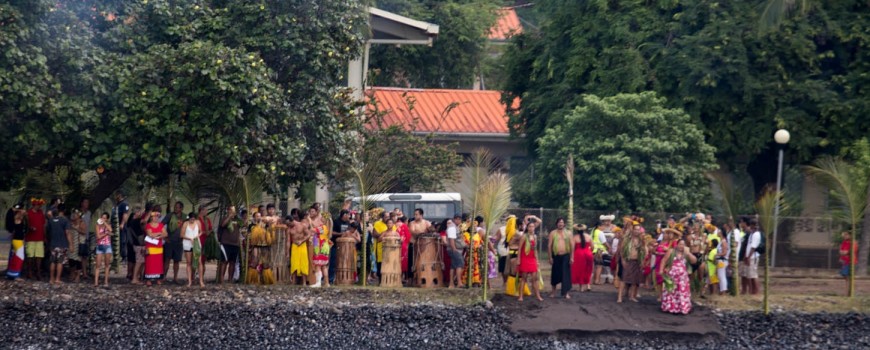
Hōkūleʻa made landfall yesterday on the island of Nuku Hiva in the Marquesas. The crew received a warm welcome from the community celebrating Hōkūleʻa’s journey around the world to share Polynesian culture and the Mālama Honua message of caring for Island Earth.

Upon arrival, the crew members met up with the family who welcomed the crew when Hokulea first sailed to the Marquesas in 1995 as a part of the Na Ohana Holo Moana Voyage (The Voyaging Families of the Vast Ocean).

“Returning to the Marquesas is a return to our ʻāina kupuna, our ancestral lands,” said Kaleo Wong, Hōkūleʻa apprentice navigator. “For hundreds of years, our kūpuna navigated their waʻa to and from Hawaiʻi. And here we are today still carrying on this navigation practice, using the same techniques they would have used, and traveling along the same ancestral routes.”

The Marquesas, or Henua Enata meaning “Land of Men,” are a group of volcanic islands virtually untouched since the era of European exploration. Their isolation has created an immense pride among the community, whose culture is a direct trace back to ancient Polynesian Maohi, or the indigenous cultures of French Polynesia. The two main islands of the Marquesas, Nuku Hiva and Hiva Oa, are each characterized by their stunning vistas, towering mountains, and secluded lush.

The crew will reach Tahiti around mid-April, traveling throughout Tahiti and Ra’iātea to engage with the local communities in ceremony and education outreach as they celebrate the close of the nearly four-year long journey. Together with her sister canoe Hikianalia, Hōkūleʻa will head home to a welcoming ceremony at Magic Island in June 2017.


Homecoming - Save the Date - Banner Feb 17 Update

Hōkūle‘a Homecoming – Save the Date

We’ve got more details for you regarding Hōkūleʻa’s historic homecoming in June 2017! Click below to find out more:
Crew Blog | Keoni Kuoha: Arrival to the Marquesas Islands

E Pae Atu i Ta ʻĀina lā: Arrival to the Marquesas Islands

Keoni enjoying the afternoonCrew blog by Keoni Kuoha

We spotted Fatu Hiva midday today. This is the fourth island our navigator, Kaleo Wong, has pulled out of the sea in the course of Leg 29 – a testament to his preparation for this voyage and the training he continues to receive from master navigator, Bruce Blankenfeld.

As we began our approach yesterday afternoon, the elements around us both guided us along the way and prepared us for our first contact with one of our Polynesian homelands. As with our approach to Henderson Island, whales lined our way as though to bear witness and support for our voyage. The birds were many, including our dependable kiaʻi, the manuokū. And a crescent moon smiled down upon us in the day’s afterglow.

At sundown, the lightning began. This would be the third night in a row that we were treated to this spectacular show of distant lights in otherwise clear skies. It was awe inspiring, but never threatening, a manifestation of the prayers for safety that the many people at home and around the world are sending our way.

As the night wore on, the elements transitioned us from the deep sea to landfall. It started in calm as a massive rain squall billowed behind us. I put on my foul weather gear for a torrent that never happened. Instead, the dark cloud split in two and escorted us toward our destination. Yet, the calm wasn’t last the whole night. The winds eventually picked up and the heavens opened up and poured, every weighty droplet washing away the salted spray of the past week.

And then it all stopped. The clouds hung low, gathered here and there, but otherwise painted in large strokes across the sky, layers upon layers of clouds. It was through this sea and cloud-scape that the trained eyes aboard Hōkūleʻa began to make out the lines of an island. Faint at first, the outline persisted in an otherwise shifting scene. Have we hit our target? Our navigator responded with a confident, ʻae! Welina mai, e Fatu Hiva!


Homecoming - Save the Date - Banner Feb 17 Update

Hōkūle‘a Homecoming – Save the Date

We’ve got more details for you regarding Hōkūleʻa’s historic homecoming in June 2017! Click below to find out more:

Crew Blog | ʻĀina Paikai: The Reward of Fresh Fish

Aina Paikai Crew blog by ʻĀina Paikai

As apart of the 2 to 6 watch, we are blessed to see every sunrise and sunset while out on the open ocean. Each of them different and special, but none better then the last. I try not to have my eye fixed to a camera, even though these golden hours give the best lighting of the day. At least for a moment, I try to take the time to breath in the smells, soak in the colors and make it a memory… and then take the picture.

In the early hours, I’d guess around 4 or 5am, when the camera can’t capture an image the same way your eyes can, the faintest light starts to creep up from the Eastern horizon, just slightly changing the darks into what’s known in Hawaiian as wana‘ao. Each morning, right at that first light, navigator Kaleo Wong and master navigator/crew fisherman, Bruce Blankenfeld, take a short break from reading the stars and set their sight on the seas, or rather what lies beneath.

This is my first time sailing with Kaleo or Uncle Bruce, but from the footage I’ve seen, their legs seem to consistently catch. Whether in the Tasman Sea or the Atlantic Ocean, they’ve pulled up some of the most impressive monsters of the deep during the Worldwide Voyage.

Our very first day on the ocean, we snatched two mahimahi right away, satiating my expectations of fish dinners every evening, but since then, we oddly haven’t had much fish on board. Two small ahi on Day 8 served a nice breakfast, but 4 fish in 15 days seemed like a low average.

So on day 16, after repeating our same prepared dry-good meals, at least twice over now heading into the third week, I asked Kaleo if there was anything we could do to liven up our lures. He thoughtfully replied, “Pule.” So I did. I said a short prayer in my head to Kanaloa, asking him to feed this crew and offer us a fish to lift our spirits and strengthen our bodies while we continue on our long voyage to Nuku Hiva.

That afternoon, right around sunset, the snap of the rubber band caught our ears indicating something had finally taken a bite. Shortly after, Uncle Bruce pulled up a greedy little Hebi or Spearfish, whose belly was fuller than any other fish we’ve dissected. He made for a nice fried-fish and scrambled egg breakfast the following morning and some poke for lunch.

Later that day, day 17, another double strike of mahimahi hit the lines at the exact same time. Kaleo and Captain Russell Amimoto, an experienced fisherman in his own right, battled with the beasts for a bit until finally pulling them up on either sides of the deck. Both fish were nearly as tall as the men that caught them! With so much meat, we gave one of the fine fish to our escort boat crew of Gershon II. They were elated, as they hadn’t seen many bites either. We later prepared fish head soup and breaded mahimahi that was the perfect balance of moist and crunchy.

Finally, just yesterday, day 18, that resounding rubber band snap whipped everyone’s heads around. “Hanapaʻa!” Again, the captain had the duty and honor of dueling with the unknown species. This one dived down, so some had suspected an ahi. Indeed the colors of the yellow fin showed itself once it neared the surface. This one, estimated to weigh over 40 lbs, was quite the handsome fish – one that we were salivating over from the first cut.

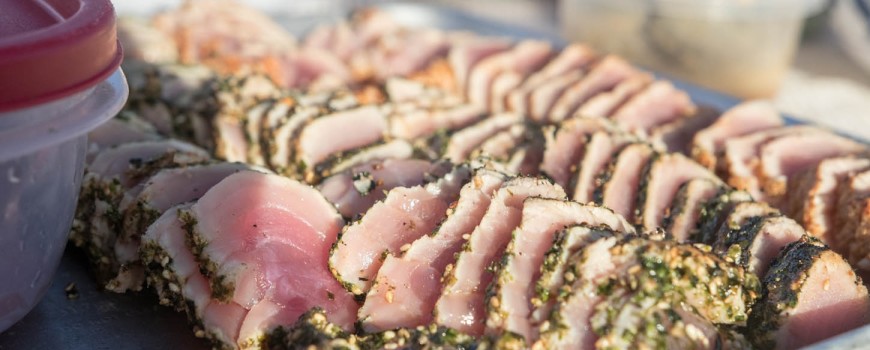
Again with so much fish, she needed to be shared with our accompanying vessel. With just one half plus the belly, we were able to make sashimi, fried ahi, seared ahi with a furikake crust, and Kaleo fashioned a drybox so that we could dry and preserve some for a later date (Update: It’s all gone by day 19). The estimated market value per crewmember must’ve been nearly $50 a head.

At dusk, with our bellies round and full, the glow from our faces matched the warmth of the setting sun. The reward of fresh fish is the invigorating boost to the body and soul that sustains us, especially in our most trying days during a long distance voyage. We are grateful with every catch and only take what we can eat, reeling in the lines after each obtained fish. This subsistence style is the same as our voyaging ancestors, and we mahalo them for our skill in seafaring and showing us how to eat from the ocean.

We’ve nearly rounded the Earth in the name of Mālama Honua or to care for our environment, especially our surrounding seas. These gifts from Kanaloa are a reminder for us islanders that in order to eat, breathe, and live the way we know how, protecting the ocean is the key.


Homecoming - Save the Date - Banner Feb 17 Update

Hōkūle‘a Homecoming – Save the Date

Sign up for updates and be the first to know as we continue to detail homecoming festivities during the week of Hōkūleʻa’s homecoming
in June 2017!

Crew Blog | Kekama Helm: Fruits of Labor; A Labor of Love

Kekama modeling for Kealopiko
Crew blog by Kekama Helm

As the anchor set and we turn to shore, we see small ATVs coming down a steep valley road. Minutes later we are greeted with the sounds of aloha, “Welcome to our island home of Pitcairn!” About fifteen people come to meet us at the pier, a little less than half of the population. We are greeted with sincere smiles and leis. After the formalities of customs, we are taken to the town square. Some of us rode on a tractor with a make shift buggy in the back. Pitcairn’s very own mode of public transportation. Laughter and smiles began to ring off of the walls of this island no bigger than the ahupua‘a of Kalama‘ula, my Moloka‘i home.

Life is simple here. With one call over the VHF radio where folks monitor throughout the island, the local store was graciously opened for us and the people came to the square with hand made crafts. In a matter of minutes, it was like we were at the Saturday market in Kaunakakai. After an hour or so we all sat together in a small circle to wala‘au and kukakuka about their home and about the waʻa. As we were taken aback by their generosity, they were also happy to have us there. A young man said, “We have a lot of visitors that come by cruise ship, but very few Polynesians ever come to visit. Its not often we have family over!”

You could see the pride in the people of this island. Proud of who they are and the way they are able to survive on such a tiny island. Shipments only come quarterly, so most of their food and wares are made and fixed by the people of Pitcairn. They work hard and make due. Life on the island is truly one of ‘ohana and community. They take care of each other.

After a quick hour tour of the island it was time for us to say a hui hou. As we were taken to the pier I was almost brought to tears with their gifts of aloha. The tiny pier was filled with fruits and veggies. From gourds of watermelons, to papayas as big as a football, bananas by the bunches and some of the sweetest liliko‘i I’ve ever tasted, all given with the sincerity of true Polynesian hospitality. In our world of constant struggle to get somewhere, we are some times humbled by the simplest acts of kindness. We are reminded that people are the most precious resource.

The people of Pitcairn Island have been able to live that way for over a hundred years and hopefully they can live their lifestyle for generations to come. As we head home to Hawai‘i, I think of my small island of Moloka‘i and the lifestyle that we live. It’s my dream that we too can continue to live this way and perhaps we can be the trend of Mālama Honua for all to strive for. I hope that visitors who come to our beautiful shores recognize our people for their choices to be small, self-sufficient and viable.


Homecoming - Save the Date - Banner Feb 17 Update

Hōkūle‘a Homecoming – Save the Date

Sign up for updates and be the first to know as we continue to detail homecoming festivities during the week of Hōkūleʻa’s homecoming
in June 2017!

Crew Blog | Keoni Kuoha: Taka and His Lineal Knowledge

Keoni enjoying the afternoonCrew blog by Keoni Kuoha

While we were in Rapa Nui, many supported our work and stay on that island. One of those who stands out in my mind is Taka Hei–he freely offered his kōkua from the day we arrived and he became part of our crew for the time that we were on-island.

The first thing you might notice about Taka is that he has a boat–a simple, open, fishing craft in the style that is common in Rapa Nui and throughout Chile, the island’s colonial authority. Taka is particularly skilled at maneuvering his craft in and out of Hangaroa boat harbor, with its web of docking lines, coral heads, and rolling surf. And we got to see his skills in action at least several times a day, since Hōkūleʻa was anchored off shore and we needed a means to get back and forth to the waʻa, provision the vessel, and stand watch. Taka and his boat were a tremendous value to our crew throughout our stay.

Although shuttling a bunch of Hawaiians to and from their canoe became a temporary responsibility, Taka’s profession is as a fisherman, and he’s well known and respected throughout Rapa Nui as such. On several occasions, when we met up with locals, they would volunteer their estimation that Taka was one of the top three most respected fishermen on the island and by far the youngest.

At first, I thought it was curious that different folks would volunteer this same local knowledge when they found out that Taka was helping us. For one, everyone appeared to have some sort of running tally of respected fishermen in their head and Taka always landed in the top three. More interesting, though, is that everyone mentioned his relative youth–he’s probably in his late thirties, early forties–as a point of interest. The kind of knowing that Taka has mastered is something often reserved for those nearing the end of their careers as fishermen, but not for Taka.

Now, although I met Taka a couple years ago, I don’t know him well enough to say whether he possesses some natural genius for his craft–honestly, I think our society attributes too much to “natural talent” to the detriment of simple hard work and perseverance–but, what I do know is that he comes from a family of master fishermen. I met his cousin some years back, while I was visiting for the annual Tapati Rapa Nui Festival, and got to meet and talk with some of his family. It became apparent soon into the conversation that his family cares for a tradition of fishing. They spoke of genealogies of knowledge and underlying meanings, reasons, and purpose, just as any master of a traditional discipline back home in Hawaiʻi would do. They spoke of fine lines of discernment and observation, things that distinguish those at the top of their field. They expressed a deep-seeded respect and value for the continuity of their lineage of knowledge, and they described their tradition as dynamic, continuously tested by critical observation and reassessment.

This was the context of learning in which Taka was raised–his excellence a natural outcome of his embrace of a family tradition. It’s a powerful context for learning. It’s also an example of a learning system for a better future, this care for lineal knowing. For one, when one’s family is the source of knowledge, it can strengthen family bonds and support total wellbeing for everyone involved. Beyond that which is cared for within families, we have many other sources of lineal knowledge within our communities, hālau hula being a common source for this type of knowing. No matter the source of knowing, though, embracing the knowledge that comes from the lived and learned experience of those who came before you benefits both the learner and the community to which the learner belongs.

ʻAʻole i pau…


Homecoming - Save the Date - Banner Feb 17 Update

Hōkūle‘a Homecoming – Save the Date

Sign up for updates and be the first to know as we continue to detail homecoming festivities during the week of Hōkūleʻa’s homecoming
in June 2017!