Crew Blog | Nāʻālehu Anthony: Aʻo aku, Aʻo mai

Blog by Nāʻālehu Anthony

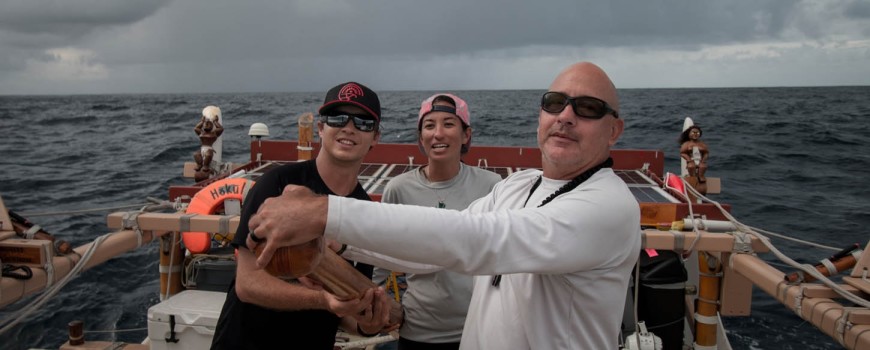
Looking at this crew at work on this canoe, I am constantly reminded of how much I have learned over the years of voyaging.

Most of this crew, myself included, have sailed multiple legs of this voyage, and have thousands of miles of sailing under our belts. But beyond that, one of the things that is so great about this leg is that many of us have earned those sailing miles together over decades. In the case of our captain Archie Kalepa, he has been sailing on board Hōkūleʻa for about a quarter century; on many of those early sails, he was side-by-side with the likes of fellow Leg 28 crewmembers Max and Keahi. For me, I came into the organization at the same time with one of the other Leg 28 watch captains, Russell; and I have been privileged to sail with at least half this crew before sometime in my 20+ years of sailing on Hōkūleʻa. As we recount different destinations and share stories about previous voyages, it’s hard to believe that this canoe has traveled so many miles and witnessed so many events.

One of the most amazing features of this canoe and all her voyages is the learning that has taken place on board, which has shaped the lives of so many individuals. If one counts the education and outreach efforts of the crews over the last 40 years and dozen or so voyages, literally hundreds of thousands of people have been on board to experience the mana of this canoe in some way.

For us on board sailing in the old way, however, we experience “learning” as totally different. Different because this crew all have large amounts of sea time and have gained years of expertise in sailing this vessel; and yet, the more we think we know, the more we realize just how much we have to learn. It’s a pretty interesting paradigm to be in as we move forward in life – realizing how with each step forward, we gain more perspective of the long road ahead. More interesting still because we get to learn this lesson and work together as a team in these “isolated from the rest of the world” experiences, where we absolutely cannot reach our destination without understanding how much we have to learn and being humbled by the journey.

And so all of us must be our best selves to get to the destination. That physical destination is an island a little smaller than Kahoʻolawe, and about as isolated as you can get. But the metaphorical destination… that’s a different story. While we are all here to do and learn more about this act called sailing and the practice of voyaging, I really believe that we are all here to learn more about ourselves. You cannot help but be introspective out here. That state of introspection is occasionally broken by the need to do something immediate, like stand for watch or sheet a sail. And even in those acts which seem routine but somehow we always have to be prepared for something different, there are those among us who haven’t spent as much time trimming sails or steering in these types of conditions, and so we have to teach as well as learn.

The ability to come to this – to any voyage, in life or at sea – with a humble heart, to balance out the teaching and learning, requires us to be true to what we know. Perhaps more to the point, we must be true to what we don’t know, and in that we will maybe find some true knowledge. It’s no wonder Hawaiians use aʻo for teaching and learning, the two must go hand in hand if we are to truly attempt either.

For me, I’m just really stoked to be here and honored to be with this incredible crew.

SB 72,
Nāʻālehu


Homecoming__-_Save_the_Date_-_Banner

Hōkūle‘a Homecoming – Save the Date

Sign up for updates and be the first to know as we continue to detail homecoming festivities during the week of Hōkūleʻa’s homecoming
on June 17, 2017!
Crew Blog | Archie Kalepa: The Test

Blog by Archie Kalepa

For me, the sea has always brought some of the greatest tests of my life; my strength, my courage and my leadership.

But this test — it is different.

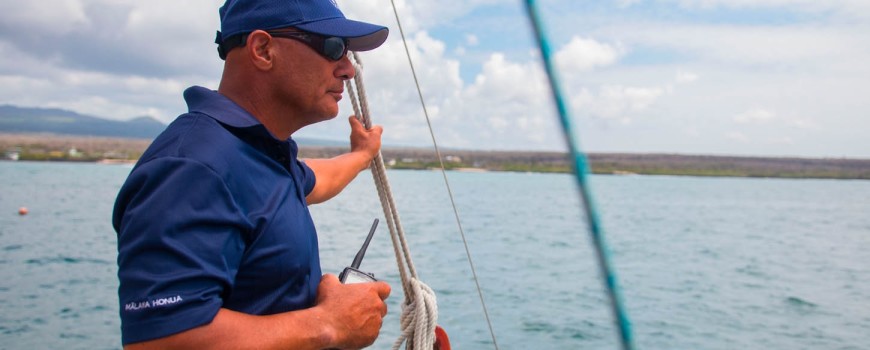
I have been a crewmember in many capacities on board Hōkūleʻa over the years, but this is the first time that I have been asked to be in charge of it all – from the sacred vessel, Hōkūleʻa, to the sacred 13 souls on board, I am humbled by (and honestly a little afraid of) this new responsibility.

Our journey started with pulling up anchor at Santa Cruz Island in the Galapagos, the first of many tests of this 1900-mile journey. We have had three anchors down for the better part of a week, to keep us secure in this bay that so many ships are moored in. The first order of business was to pull the anchors in the correct sequence, being careful not to get too close to the other vessels, and then safely hook up a tow with Gershon II. Our crew worked together to get through this seemingly small but immensely important task, building trust and confidence together at the start of our journey. IMG_1256They didn’t say anything in particular, but I saw big smiles and got head nods as if to say “Good job, Captain!” Uncle Billy Richards, veteran crewmember and mentor, later came to me and said our departure was “textbook” – again, a great sign that we passed some test and learned what the lesson had to offer.

These lessons have come in bits and pieces, like a puzzle – lessons to be found in the elusive wind, the swell direction, the clouds and how they hide our precious stars. The patch of rain last night taught us a lot about ourselves — the test was having to use our other senses, as our eyes were muted by the dark sky where not even the moon could get through. By early morning we entered into a dark black hole of a cloud that maybe would not have been a daunting sight for a Pwo navigator, but this new navigation team is testing themselves, under myself — a captain new to this position. This may have been intimidating, but lucky for us we have a seasoned crew, with many deep-sea crossings in their past, who are eager to support the navigation team in every way. Our navigators held the line, and when we IMG_1433popped out of the cloud having nothing to rely on but swell, the navigation team was right on point. The lesson? Be patient, trust your decisions, and trust your crew. These are lessons lived and learned in the purest form!

All this is possible because we have had great teachers; Nainoa, Bruce, Kālepa, Snake, Terry, Clay, and many many others – all of them come to my mind. We would not be right here, right now, without them. On behalf of the Leg 28 crew – Mahalo.

We’ll be standing by 72,
Captain Archie Kalepa


Homecoming__-_Save_the_Date_-_Banner

Hōkūle‘a Homecoming – Save the Date

Sign up for updates and be the first to know as we continue to detail homecoming festivities during the week of Hōkūleʻa’s homecoming
on June 17, 2017!

Hōkūleʻa Update| February 11, 2017

Naalehu AnthonyBy Nāʻālehu Anthony

Aloha nui kākou,

The sun just set on our second day of Leg 28 from the Galapagos to Rapa Nui. Our crews are in great shape and everyone is safe and healthy. We are heading in a generally southern direction, with an attempt being made to get a little east of south. At sunset we are estimating that we have traveled 132 miles south. We will continue on this course until we find some stable and reliable wind, which will likely take a couple more days. At current the wind is out of the East at about 5 kts; too light to sail, so we are still under tow looking for the wind line.

Since our departure from Galapagos, we have seen an incredible amount of wildlife. Huge rays jumped out of the water yesterday and a shark hung out at the aft of the canoe. Birds are plentiful in number and variety; we’ve seen ‘iwa, koaʻe and booby birds. Still no luck with any fish, however. Russell is trying hard, changing lures over the course of the day, adding lines to multiply the chances of landing something. Our meals are still in the process of transitioning from land food to canoe food – Max brought on a bunch of bread yesterday so we modified the canoe meal plan to make use of the fresh bread with French toast this morning for breakfast, and ham sandwiches with cheese and tomatoes for lunch. For dinner, we had spaghetti in a faux meat sauce; Uncle Billy added a bunch of fresh veggies to the mix that really spiced it up. We also spent some time cleaning the deck today, washing away the dust that gets tracked on the canoe as we come from shore. The whole crew worked to clean our home to make sure she is as spotless as possible, and the shine from all the effort in drydock still shows.

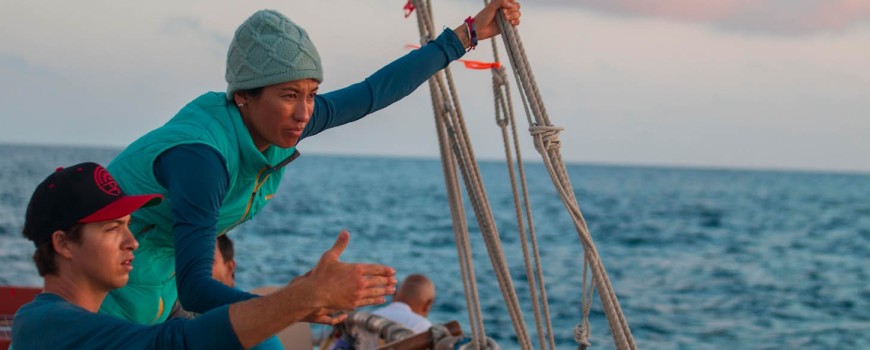
In the midst of these transitions from land to sea, big and small, perhaps the most important is when our navigators take their studies and turn them into practice. These next 1800 miles are really all about the navigation – the four navigators on board will work as a team to find one of the hardest targets on the planet. There is no real landmass between where we have been to our intended target, Rapa Nui. That means that the only tools these individuals have to work with are their knowledge of the stars, the directional cues they derive from their observations of nature, and their reliance on each other as a team. They have together memorized table after table of where stars rise and set, and how they move across the sky throughout the night. This time we’re spending looking for wind is a warm-up for them, to dial-in everything they have studied and to put that training into practice. I feel really blessed to be a part of this leg, to witness this team working so hard to measure our movement across the emptiness of this region.

I’ll be writing more details about the navigation aspect during this leg, in an attempt to help those who have expressed interest in getting a deeper look inside navigation understand what our nav team is planning and doing. We’ll dive into that tomorrow with a look at the set of equations and parameters that make up this run from Galapagos to Rapa Nui. For now, mahalo nui to you all for your support as we make our way just East of South on board the mama canoe, Hōkūleʻa.

We’ll be standing by 72,
Aloha from the crew,
Nāʻālehu


Homecoming__-_Save_the_Date_-_Banner

Hōkūle‘a Homecoming – Save the Date

Sign up for updates and be the first to know as we continue to detail homecoming festivities during the week of Hōkūleʻa’s homecoming
on June 17, 2017!

Hōkūleʻa Pulls Anchor in Galapagos, Heads to Rapa Nui

After a week of meaningful exploration and engagement with conservationists, plentiful wildlife and warm local hospitality, the crew of Hōkūleʻa set sail today for Rapa Nui, also known as Easter Island, marking Hōkūleʻa’s return to the navigational ocean currents that will lead her home.

During their visit to the islands of Galapagos, the crew of Hōkūleʻa invited teachers and students from James B. Castle High School, Kamehameha Schools and Halau Ku Mana Public Charter School to join them at the UNESCO World Heritage Marine Site in learning more about the islands’ fragile ecosystem and discussing best practices for how to conserve the earth’s most critical resources.
“Heading to Rapa Nui, Hōkūleʻa carries the invaluable lessons of global sustainability that were learned and shared at other UNESCO World Heritage sites such as the Galapagos Islands,” said Nainoa Thompson, president of Polynesian Voyaging Society. “In addition to being a recognized global resource by organizations such as UNESCO, Rapa Nui signifies a major cultural return for Polynesian navigation and our Worldwide Voyage as we re-enter the Polynesian triangle, the birthplace of our wayfinding heritage.”
Hōkūleʻa is expected to port in Rapa Nui around February 28, weather permitting. The crew will stay on the island for approximately a week before sailing on to French Polynesia. The crew will again be joined by a contingency of teachers and students from Hawaiʻi.  The last time Hōkūleʻa visited Rapa Nui was on a voyage that took place in 1999.
Host to famed archaeological sites including nearly 900 monumental statues called moai, Rapa Nui is a remote volcanic island located in Polynesia under Chilean territory. Rapa Nui represents an opportunity for the crew to learn more about the island’s status as a World Heritage Site as well as the rich cultural history of its Polynesian ancestors.

Homecoming__-_Save_the_Date_-_Banner

Hōkūle‘a Homecoming – Save the Date

Sign up for updates and be the first to know as we continue to detail homecoming festivities during the week of Hōkūleʻa’s homecoming
on June 17, 2017!
Hōkūleʻa Update| Seeking Protection – from ʻAwa to Outer Wear

Naalehu AnthonyBy Nāʻālehu Anthony

Yesterday, the crew of Leg 28 loaded almost all of our personal belongings on to the canoe. What could have passed for a product show for Helly Hansen, Patagonia and Pelican luggage was just another day in waʻa life. While we may or may not be brand conscious (some of us more than others), we most definitely need gear that will stand up to the rigorous tests we put them through while sailing this canoe. One miserable night-long squall in the biting cold is all it takes for you to understand the value of good gear. In many respects, the gear we wear is really the only protection to be found on the canoe. Only a thin layer of canvas keeps the wind and waves out of our bunks; if you ask the likes of veteran crew like Keahi Omai and Max Yaramawai, sometimes even that canvas doesn’t hold up. And so we see a lot of inadvertent trial-and-error of the gear on each leg with crew sporting new equipment, in constant search of gear that keeps us warm when we are cold, and cool when we are hot. Sometimes gear sponsors like Patagonia and Olukai want to hear from us about the equipment – and after 31,000 miles of sailing three-fourths of the way around the planet, I think it is safe to say that we have some pretty unique testing conditions. Beyond the extreme weather and wear-and-tear, we gladly provide that feedback and support to our sponsors and partners based on the values of voyaging and mālama honua, so they can help us to guide Hōkūleʻa and her crew forward in a positive way by being as environmentally-friendly and low-impact as possible. Well-made gear that lasts a lifetime is far better than gear that has to be constantly replaced and adds to our footprint on this Island Earth.

gear galapagos

But the readying of the canoe, loading gear, and checking off kuleana lists is just part of the process of making sure everything is right for departure. There is also the part that connects us now, here on the deck of Hōkūleʻa, back to every voyage undertaken in this ancient way, to times when these canoes were the only way to get from island to island in the vastness of the deep blue sea.

These vessels, the spacecraft of our ancestors, born of the innovation and ingenuity our ancestors utilized to build and sail them, were made of physical things but grounded in a deep respect for the things that could not be seen. Beyond the art and science of wayfinding is the reliance on ritual to help voyagers find their way.

‘Awa (kawa, kawakawa, or even sakau) is familiar throughout almost the entire Pacific — and so it was for the 14 of us this night. As the sun set over this small town, with our canoe slowly swaying to the gentle rhythm of the land breeze, we sat together and drank ‘awa in ceremony. The intent is that which it has always been, I think — to bring us together, to pause in the chaos that is a voyage, to look around and be present with one another as we are about to embark on a journey that is nothing short of impossible.

The math tells us that the ability to find a target as small as Rapa Nui is pretty impossible using the system of navigation that we use. Putting the math aside for a minute, let us consider that thousands of years ago, Polynesian navigator Hotu Matuʻa found the island. In his wake, many other navigators whose names have been washed from our memories found the island as well. And on the deck of Hōkūleʻa, sitting next to the steering paddle named for the sacred beach of Kualoa, we are reminded that this canoe too, with our navigator, found that impossible place in an impossible dream only 18 years ago. Interesting how the impossible becomes possible when we come together and work as one.

As each apu is poured, so too does each person pour into the ʻawa circle their hopes and dreams about this voyage and how they got here. This short time we spend talking about why we are here and what we want to contribute gives us the clarity we need to push on – past the adversity, past the heat, and past anything we wanted for merely ourselves. We are back in the Pacific after more than two years, and about to enter the third corner of the Polynesian Triangle with a group of individuals who represent the effort of countless others that have worked the last 4 decades to get here. As Venus rises above the Ki’i Wahine, Orion stands overhead, and we are awash by Mahina the moon, we do as we have done for thousands of years – we ask those who cannot be seen for protection, to help us reach our destination as one.

Kihawahinekamoʻoomaluʻuluolele illuminated by the rising sun.

Na mākou me ka ha’aha’a,
Nāʻālehu Anthony on behalf of the Leg 28 crew


Homecoming__-_Save_the_Date_-_Banner

Hōkūle‘a Homecoming – Save the Date

Sign up for updates and be the first to know as we continue to detail homecoming festivities during the week of Hōkūleʻa’s homecoming
on June 17, 2017!

Continue Reading

Crew Blog | Sam ʻOhu Gon: Hawaiians exploring a new world

IMG_0093

By Sam ʻOhu Gon III

Imagine arriving by voyaging canoe to an island for the first time, and while circling the dry coastline intent on a place to land, the eyes moved from the dusty grey dryness of the leeward lowlands up into the kua uli, the dark lush, vegetated uplands, knowing well that in that zone would be forest, ferns, bird life, perhaps flowing water, all the markings of the wao akua, the sacred realm occupied by the gods.

IMG_9081

The lāʻau lapaʻau of the crew would fully expect that even though this was an island they have not seen before, some of the kino of their akua would be present, some of the physical manifestations commonly encountered in their home island would be there: the winter-flushing ferns of Lono, the hardwood trees of Kū and Kāne, the uluhe mat ferns of Hina perhaps. So, with eyes trained for recognizing those kino, they might find themselves climbing into the misty summit of the island with pule and hoʻokupu, eyes ready for the familiar as well as the new. Those familiar forms would immediately be called by their names, while those that were unfamiliar would be examined very closely, the leaves, the form of the tree, its bark, its strength, the form and color of its flower.

The same discerning powers of observation that were required for oceanic voyaging — the tiniest details of the winds, rains, ocean swells, the myriad bird life forms and their individual behaviors and ecologies–would be brought to bear on the living universe of the uplands.

And so, as we explored the Galapagos highlands yesterday with students from Hawaiʻi, we took note that some of the ʻalaʻalawainui pc: sam ohu gonfamiliar life forms of home were immediately apparent: ʻalaʻalawainui sitting delicately upon moss-covered branches of forest trees; wāwae ʻiole springing up through the understory with their familiar rat’s foot forms; kīlau pueo prominent as the tallest fern, and assuming rapid dominance in the shrub layer, wāwaeʻiole pc Sam Ohu Gontriggered by the start of the Galapagean wet season. Other fern shapes that might have been relatives of species in Hawaiʻi were also apparent, lending the understory a very comfortable, familiar feel. Truly this was a kindred volcanic island of the moana nui. Exploring the shoreline, many of the seabirds soaring overhead were also immediately nameable: ʻiwa gliding
kīlau pc Sam Ohu Gonin the still, humid pre-storm sky, blue-footed ʻā perched on small offshore islets, noio hovering and landing on the manu hope of the canoe. But there were many other birds of shoreand mountain that were not immediately Hawaiian. The small songbirds, including all of the famous Darwin’s Finches, required that we had familiarized ourselves with their forms vicariously, through our research prior to arriving in the Galapagos.

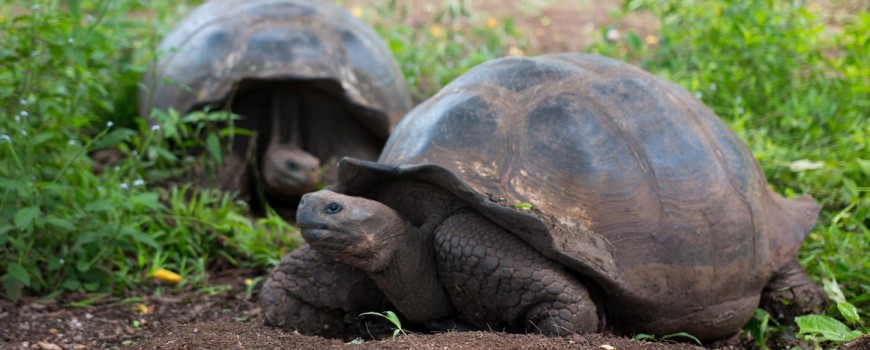
And in the midst of this familiarity – so many other things were entirely unfamiliar! Black moʻo greeted the canoe IMG_0257in the waters near shore, and covered the lava coast in some places, unlike anything we knew at home! Their counterparts of the land were also present, and confirmed the long-appreciated pattern taught by the Kumulipo: that the diversity of life on the land is matched by the life of sea, and that the kuleana of the land is a guardianship relationship. Gigantic tortoises, ʻea pilikua, plodded across the open understory of the highland forest. Such a contrast the dry arid lowlands offered! Nearly all of the plants offered entirely unpleasant arrays of spines. Even the tallest tree of the kekaha wai ʻole, the waterless leeward paniniregion, was a gigantic panini cactus with an armored trunk that shared some of the same ʻano as an old wiliwili tree… If the Galapagos had been encountered by voyaging Polynesians in the course of the colonization of the Pacific, you can be sure that in a remarkably short amount of time, the names of features of land and sea, including all of the plants and animals, would have been assigned, and their relationships with each other (and to people as but a part of the living universe) would have been explored. It is not only the names of things, after all, but their ʻano, their character, that are important.

It is the ʻano of things that captured the eyes of Hawaiʻi ʻimiloa, far-sighted Hawaiians. They would be continually learning, testing what they had been taught through oral tradition, comparing their learnings with others around them that held knowledge, and the accumulation of ʻike would be many generations in both length and depth. As Kepelino said, “Ahu kupanaha ia, Hawaiʻi ‘imi loa!” An incredible storehouse of knowledge, those far-sighted Hawaiians!” And so, as the Worldwide Voyage sweeps toward its culmination, what an incredible storehouse of experiences the crew and all who have been touched by the waʻa have enjoyed! 

This experience cannot merely be a matter of a string of experiences gathered along a 60,000 mile voyage, but it must serve as the impetus for the re-establishment of the tradition of Hawaiʻi ʻImiloa: people of Hawaiʻi expert and continually learning in all that they do, knowing the language of the sea and the land, as they would know the most intimate details of their genealogies and their living families. Without this, we cannot establish the relationship with our Island Earth that we will need to achieve the ideal balance to truly mālama honua, to have both our world and our people thrive in harmony. Just as the Worldwide Voyage of Hōkūleʻa has been, it is not an easy course to follow, but it is a necessary one that honors the best of our ancestors.

Sam ʻOhu Gon III is a Senior Scientist and Cultural Advisor at The Nature Conservancy of Hawai’i.


Homecoming__-_Save_the_Date_-_Banner

Hōkūle‘a Homecoming – Save the Date

Sign up for updates and be the first to know as we continue to detail homecoming festivities during the week of Hōkūleʻa’s homecoming
on June 17, 2017!

Hōkūleʻa Update| February 3, 2017

Number 82

Naalehu AnthonyBy Naʻalehu Anthony

Wrapping one’s head around the history of these islands is a complex process. I am surely not knowledgeable enough about the Galapagos to share the history with enough accuracy to be credible. But for the purposes of this story there are a few facts that you need to know to understand the significance. We all know that Darwin came here with the sailing ship the Beagle and found finches that were different in character on each island. This would lead to the theory of evolution that many use today to explain diversity in the biosphere. The giant tortoises are another example of that. The different tortoises also had different characteristics manifest over time on the different islands. This place was still uninhabited by humans when the time of western sailors came through here looking for treasure, food and water. I’m told that there are stories of buried treasure in this place as pirates came and went throughout this landscape. But what we know for certain is that these marauders also took the treasure of resource from this place. There were hundreds of thousands of tortoises across the islands and over time they grew fewer and fewer in number. They were great source of protein on the sailing ships because they could live for a very long time. Also the oil from them was used as an early source of heating and lighting. Fast forward to just a few decades ago and we can clearly see the effects of all of that unchecked abuse of the resource, as invasive animals like the rat took up the work that the pirates started. We know the story of lonesome George who was the last giant tortoise of his kind anywhere in the world and on June 24 2012 the world also bore witness to the extinction of a species when lonesome George died. This sobering reminder is a story that gets repeated more often than most people would like to admit, but for the people here, they were already working hard to preserve what they could.

image1 (5)As this place became a National Park with the protections and resources of the Ecuadorian government, a program started to try to turn back some of the damage that had taken place to the giant tortoise populations. A protection and breeding program was started on this island of Santa Cruz in an attempt to save some of these species that were critically endangered. In one case on one of the islands, only 5 of these spectacular animals remained. In the course of only a few decades this hugely successful program has turned around the population of many of these animals. Literally thousands and thousands of these animals have been born, fed and grown to the size where they can be let out into the wild once again and live as their ancestors did. Everything in their lives is closely documented so that they can be returned to the same island and the same place where their eggs were harvested.

image4 (1)But the story does not become real until you get to visit this highly protected venue. Not many get to come to the tortoise facility as the lives of some species are literally held in the balance on this small piece of land in the corner of the National Park. A few of us from the crew got to go here for a special honoring of the voyage, but what we saw was nothing short of life changing. As we crossed into the secure location having to first clean our shoes in a water soaked set of mats, the environment quickly revealed a sea of pens with hundreds and hundreds of baby tortoises. They were grouped by island and date of birth. These creatures that become giants over the course of their lifespan of more than a century are just a few weeks or days old in some cases here. We learned about how the eggs are heated to a different temperature in incubation to get a maleimage3 versus a female and that without this program many of these species would have already perished. Even in this secure facility, the tops of the pens are covered with thick screens to keep out the predators that are certain to be nearby at any time. This is a sobering reminder that much has changed in this place since these moving mountains were at the apex of the food chain here.

And so you can imagine how special each one of these gentle soon-to-be giants are. The head of the National Park brought us through the facility to make our captain of the voyage and PWO navigator Nainoa Thompson the godfather of tortoise number 82. This one was appropriately named Hōkūleʻa at the ceremony and further solidified the connection between the people of this place and the people of Hawaiʻi. We all agreed that we have kuleana here with tortoise 82 and will have to come back and visit. The hope and inspiration that comes out of a day like this is the fuel that propels us forward through these last few months of the Worldwide Voyage.

image2SB 72,

Naʻalehu


Homecoming__-_Save_the_Date_-_Banner

Hōkūle‘a Homecoming – Save the Date

Sign up for updates and be the first to know as we continue to detail homecoming festivities during the week of Hōkūleʻa’s homecoming
on June 17, 2017!

Crew Blog | Shawn Kanaʻiaupuni: Learning the “Language” of Nature

Educating for Mālama Honua: Learning the “Language” of Nature
A reflective blog from Leg 27 aboard Hōkūleʻa in Las Islas del Galapagos

Shawn Kanaiaupuni

By Shawn Mālia Kanaʻiaupuni

What is the education our children experience in todayʻs schools? What kind of education do they deserve, that best prepares them for the future? These are the kinds of big questions our crewmembers pondered aboard Hōkūleʻa as we sailed from Panamá to the Galapagos Islands on Leg 27.

When most people talk about education in the United States, the conversation often turns to a long list of negative descriptors – outdated instructional models, overly focused on test scores, driven by textbook companies, lacking relevance to real problems and real life, not engaging our students or attracting our best teachers and leaders. Behind the naysaying, though, is a deep-seated belief that education is a singularly critical process in bettering ourselves as individuals, as a society, as humanity, everywhere around the world. Itʻs sometimes easy to forget that for many people around the world, education is a privilege not equally accessible to all. The U.S. is no exception. In Hawaiʻi, Native Hawaiians, like other culturally and linguistically unique peoples, have fought and continue to work toward greater equity in educational opportunities and outcomes for our keiki. Equally important and also likely to be forgotten is the need to educate for equity with the natural world living alongside us on this special island called planet earth. In this call to action, indigenous science and perspectives provide a wealth of knowledge, approaches, and tools.

The Mālama Honua Worldwide Voyage is a commitment to learning and caring for our larger “island earth.” It combines indigenous and contemporary science and technology to solve complex issues informed by ancestral values-based knowledge and practices developed through keen observation about island living. It calls us to learn about the relationships between people, our oceans, our lands and everything in or on them.

Throughout the many ports that our treasured Hōkūleʻa has visited, we have discovered different educational issues

and solutions. In the Galapagos, our crew was blessed to meet some amazing people committed to educating children to embrace our human interconnectedness with nature. On February 2, a few members of our crew visited the Jardin del Mar (Garden of the Ocean), a beautiful little school with about 15 children ranging from 2 to 4 years old. We built them a little canoe from the blocks in their playroom and taught them how to navigate using the sun and the four cardinal points, east, west, north, south. At one point, when we did our imaginary hike up to the “highlands”, the mountainous area, to find a tree big enough to cut down and carve, the students became quite agitated that the birds would no longer have their homes. Their teacher reassured them that we were only cutting one tree, and the “pajaritos” would have many others to play in.

As she explained the treeʻs purpose, I thought about the line between felling just one tree and many. Consider the many different species of birds (and trees) displaced and extinguished in the process of serving human needs requiring not just one tree but entire forests, in nation after nation around the world. How will our children learn to balance human consumption in ways that permit nature to “self-correct” and accommodate our cumbersome footprint?

Key to the mission of Mālama Honua Worldwide Voyage is the idea that people will fight to protect what they care about. But we (kākou, all of us) cannot care for what we do not understand. Going around the world to discover and share stories of hope helps build understanding, unleashing greater possibilities to innovate and protect by connecting a caring community, by weaving a lei of hope one person at a time across the globe.

Also central to the Worldwide Voyage is the Promise to Children and its commitment to inspire children to explore, discover, and learn about Island Earth so that they are better prepared and empowered to navigate toward a better future. Fueling this change is possible, even if it starts out small. It happens classroom by classroom, school by school, and district by district.

Our Leg 27 and Leg 28 crews reflected on at least three differences that the majority of children grow up understanding in the Galapagos as sense of place, in contrast to the seemingly disconnected experiences that many children in Hawaiʻi and/or the United States encounter:

  • Relationship, with nature, cultivated from interacting daily with the native, natural environment and adults modeling respectful relationships.
  • Interdependence, based on the connection between human actions and the environment. Itʻs observable, the economy, their parentsʻ jobs, industry – all rely heavily on that understanding.
  • Coexistence, experiential knowledge about how human activity can be managed and regulated to privilege nature as part of everyday life. Galapagueño community members vigilantly guard efforts to achieve greater equity with nature, including limits on the number of tourists or others in any area, respect for wild and plant life, restricted population size, and sanctioned activities.

The “keys to cracking the code” of how we best care for the earth is in our own ʻike, argues our Captain Nainoa. Examples like the Kumulipo are evidence. A genealogical chant of “rememberance from the lipo of our deep past to the lipo of our unknown future,” the Kumulipo conveys the carefully cultivated Hawaiian scientific mindset and keen observation skills developed through the lens of interdependence and kinship between kānaka and our honua, ʻāina, and kai (quote from Pua Kanahele, also see the two blog references by Sam Gon and Russell Amimoto at the end of this article). This approach stands in stark contrast to more individualistic, technical teaching conventions of Western science. Why is it that our children donʻt benefit from both knowledge systems?

The big question is how can we as educators − whether at home, in our communities, or at work, find ways to transform education for children in Hawaiʻi? The Promise to Children signers and supporters have identified seven objectives:

  • Actualize our Promise to Children with culturally rich, deeper learning experiences for students to mālama honua
  • Provide teachers with tools to engage students more effectively in learning the language of nature
  • Support families to come together as communities to mālama honua
  • Discover and develop proof points, models of success, to share and disseminate
  • Institutionalize our efforts through systems change
  • Share Hawaiʻiʻs story as a learning example of island living and sustainability
  • Increase awareness of environmental justice issues through education

File_004

Check these out for more insights!
http://www.hokulea.com/crew-blog-sam-ohu-gon-hawaiians-exploring-new-world/
http://www.staradvertiser.com/2017/02/01/editorial/island-voices/hawaii-galapagos-share-a-mission/


Homecoming__-_Save_the_Date_-_Banner

Hōkūle‘a Homecoming – Save the Date

Sign up for updates and be the first to know as we continue to detail homecoming festivities during the week of Hōkūleʻa’s homecoming
on June 17, 2017!