Crew Blog | ʻAulani Wilhelm: Twelve Strangers and a Dog

aulani wilhelmBy ʻAulani Wilhelm

Twelve strangers and a dog boarded Hōkūleʻa when we arrived into Puerto Baquerizo on San Cristobal Island, the capital town of the Galapagos and first port of entry for foreign vessels entering National Park waters. They arrived by water taxi as we anchored offshore, to ensure we did not bring any unintended pests or pathogens above or under the water to their islands or waters. Representatives from Immigration, Biosecurity, Port Authority, Anti-Narcotics, Customs and the National Park all reviewed our passports, had us fill out paperwork to enter, and inspected the 60 foot waʻa from hull to stern.

IMG_9688So careful was the inspection that the blackish-brown, shepherd-collie mix sniffed every bag, every person and each hold before deciding it was too hot to do anything except lie down and pant. A woman armed with an insect vacuum meticulously ran the nozzle in each corner of our makeshift bunks, around each deck box, and along the edge of the fabric canvas. A diver was also sent below to inspect our hulls, which had been scrubbed the previous day by Nainoa, Archie Kalepa and John Bilderback to ensure we hadn’t picked up any free riders since the hulls were professionally scrubbed in Balboa, Panamá.

The canoe was squeaky clean, and according to Nainoa, perhaps the cleanest it had been in years. Why? Because we had made a mistake. We hadn’t fumigated the canoe prior to departing Panamá – a primary and very clear requirement of the National Park. The canoe had been inspected in Colon, on the Caribbean side of the Panamá Canal to meet Panamanian requirements. It was deemed clean enough not to require fumigation for Panamá. However, in Balboa, on the Pacific side of the Canal, the canoe needed to be fumigated prior to leaving port with documentation of the fumigation in order for us to be granted our entry permit to come ashore in the Galapagos. The Colon paperwork was submitted but upon careful examination by our Ship Agent, Luis “Champi” Rodriquez who was helping us obtain the proper authorizations to enter the Galapagos, he recognized it was insufficient. Unfortunately, we were already under sail and nearly half-way to the Galapagos when he contacted us.

DSC04864Our captains, Nainoa, Billy and Archie faced a hard choice, keep sailing in hopes we can sort out the requirements en route and organize an at-sea fumigation (which we weren’t sure was possible) or turn east and head for Guayaquil, Ecuador and not take Hōkūleʻa to the Galapagos at all. There were dozens of reasons why we needed to go – importantly the 24 students and teachers from Kamehameha, Hālau Kū Mana, and Castle who were flying in to be part of our arrival and exchange, among them. But ethically and morally, how could we go if we hadn’t met the bio-security requirements necessary to earn the privilege of visiting these most amazing islands? It seemed counter to everything Mālama Honua stands for. None of us were willing to take the risk that we could bring the next invasive weed, scale, or other damaging micro-organism to shore that could alter the land or sea. Nainoa was ready to take the canoe to the continent and had begun discussing alternate ways to change crews in Guayaquil, fly leg 27 crew to the Galapagos to continue the education and community mission, but leave Hōkūleʻa in Ecuador and depart for Rapa Nui from there. No one felt good about that either, and nothing the ocean offered that day in terms of beauty or calm seas helped to change the achy feeling in our collective naʻau.

We were so lucky to have an advocate in Champi and a friend in Norman Wray, the head of the Galapagos program for Conservation International. They had worked tirelessly for weeks on our entry application to try and get a process that normally takes up to one year completed in less than 2 months. Champi was working every angle and connection to help us find a way to obtain an at-sea fumigation of the canoe and then obtain entry, three days earlier than we had originally applied for because the journey was shorter than anticipated. He was so committed to ensuring Hōkūleʻa arrived to his home islands. We hadn’t yet met Champi, but from what he had learned about our mission through the application process, he clearly understood not only what we were about but why, in his opinion, it was so important for us to come to the Galapagos. In an email he wrote to me just a few days earlier he said:

“We only want to know about you and your folk, your ocean faring and sailing…and show our boys and girIMG_9665ls about Hawaiian sailing canoes and how you sail together, and sail together with us.  

We have a society that faces the mountain. The only ones looking toward the ocean are a few…most people here don’t see the ocean as as freedom, but as a wall.

We also have urban people who only want to look at screens and phones…but they could get interested, interested because of you and your example. Help us share how islanders are and how amazing the ocean is.”

We had to take the chance of being turned away. So we proceeded.

While waiting for news from Champi, we spent 2 days emptying each of the 14 holds in the hulls, wiping each box, sail bag and action packer with a mild saltwater chlorine solution to disinfect them. We wiped the floors, ceilings and walls as well before placing all the clean gear back in, re-manifesting each item meticulously. The deck, canvases, catwalk, manu, navigator chairs, sweeps, rails, and topside holds were scrubbed and disinfected as well. All organic food material was eaten or disposed of far outside the 40 mile boundary of the National Park. Polypropolyne lines were dragged in the ocean, along with nets and any other material that may have been holding insects or eggs, to dislodge any vectors of material or disease. And backpacks, dry bags and all personal gear were inspected and cleaned. The potential impact each footprint we make on the earth became clearer and clearer to us as the cleaning process proceeded. Many had never thought about the potential that a back pack used in New York City could have in an endemic landscape in the Galapagos, or what a hitchhiking seed on a shoe could do to a struggling landscape in Rapa Nui, if it led to one more invasive species assault on an already beleaguered ecosystem. The learning process, sharing, and pulling together as a crew was heartwarming.

Forty-seven emails and nearly a dozen satellite phone calls later, we were given provisional authorization to enter Puerto Baquerizo to be inspected, with the potential of entry authorization if we passed.IMG_9081

As the inspection proceeded, the formality and guardedness that the inspectors brought on board with their uniforms quickly dissipated as the purpose and mission of what we were doing began to sink in. With disbelief in their eyes they kept asking in hybrid span-glish, “Here sleep you?” “Es is your cucina (kitchen)?” “Combien anos the voyage?” It was clear that the young twenty-something officials were imaging themselves on board and wondering if they would be able to do the same. “Crazy?” I asked using hand gestures to make my point. “MUI loco!!” (super crazy) was the response I got from the pistol-toting narcotics officer in charge of the sweet canine.

‘Why were we doing this?’ they all seemed to wonder. Their questions sharpened our resolve to get really clear as to why we had come and what we needed to do while in port to help fulfill our mission. The Galapagos, like the Great Barrier Reef, is a critical port of call to bring voice to the myriad of issues facing our oceans and our planet. More importantly, the Galapagos is perhaps the best example of how crucial (albeit really hard) it is to safeguard nature so it can continue to provide the services we, as humans, need to survive on the planet. As a World Heritage Site under UNESCO and one of the strictest national parks on the planet in terms of regulations and requirements that put wildlife first, the Galapagos has been a global conservation pioneer.

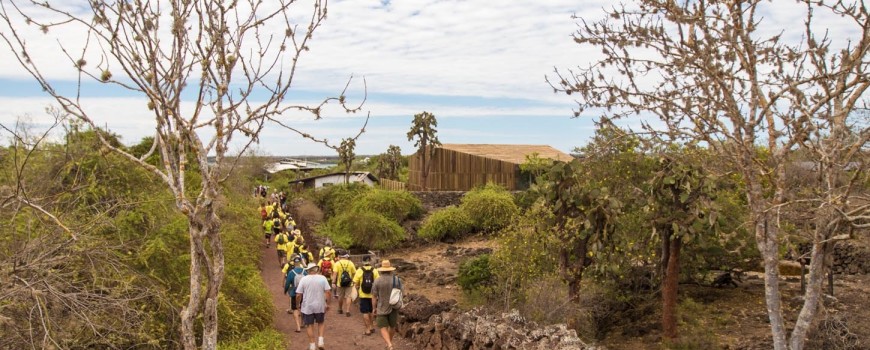
Before disembarking, the representative of the National Park gave us a short briefing. Amongst his welcome he said, “Hawai’i is for us what we don’t want to become.” It was sobering. Compared to most places in the world, Hawai’i has been held up as a standard of beauty, quality of life, and natural resources. But the truth is, we have let the standards we hold for ourselves, at least in the main Hawaiian islands where we live, slip. We no longer hold Hawai’i the way those here in the Galapagos hold their islands, as bastions of natural wealth, and as places worthy of the highest levels of protection. They have designed a socio-ecological system that enables people to live with nature, without ‘softening’ it for tourists or residents, where human ‘compromises’ like not being able to own a car for most people are seen as enhancements to the quality of life. Sharing sidewalks, restaurants, swimming pools and roads with wildlife is the way of life. And animals have the right of way – no approaching, harassing, altering behavior of wildlife is allowed, nor is gathering or collecting of any material of any kind. With most people involved in tourism here as the foundation for their economy, people understand the direct connection a healthy environment has on the economic and human health of their families.

DCIM100GOPROG0409931.

We passed the inspection with the biosecurity officer remarking that we were one of the cleanest vessels ever to pull into port. The hulls got a thumbs up from the diver, and we were then given instruction to disembark so the fumigation could proceed. We did the best we could without chemicals, now we would rely on the professionals to make double-sure nothing was left behind. Now the mission could begin with a clear na’au and conscience. Our learning from and sharing with the Galapagos had only just begun.

Many, many thanks to National Park Service Director Walter Bustos and his incredible staff, Luis “Champi” Rodriguez, Norman Wray, Scott Henderson, and all the bio-security, immigration, customs, and other officials who were strict but kind in how they worked with us to enable we were able to come into port.

ʻAulani is a crewmember and Senior Vice-President for Oceans at Conservation International


Homecoming__-_Save_the_Date_-_Banner

Hōkūle‘a Homecoming – Save the Date

Sign up for updates and be the first to know as we continue to detail homecoming festivities during the week of Hōkūleʻa’s homecoming
on June 17, 2017!
Guest Blog | Chris Huerbsch: A Speech for Hōkūleʻa

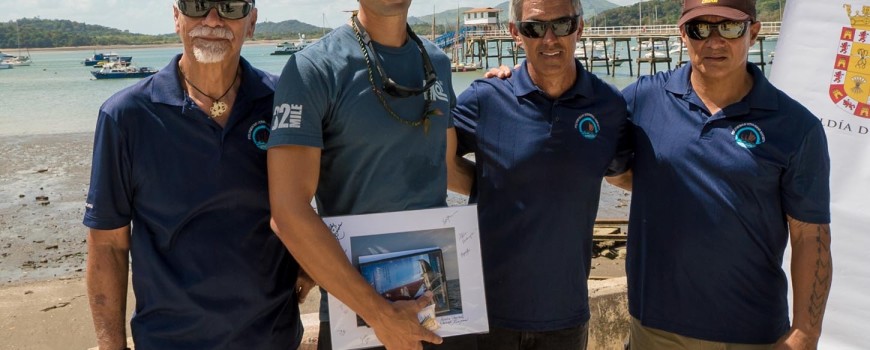
Chris Huerbsch, president of the paddle club, CREBA, was one of Hōkūleʻa’s generous hosts in Panamá. He delivered this moving speech to Hōkūleʻa crew and others on January 15, 2017.

We live in a world where we have been systemized…most of us are in the “rat race” just struggling to maintain our current level of comfort.  We work jobs that demand more hours of our attention then our natural capacity to give attention.  We are surrounded by a plethora of superficial, mindless entertainment that struggles to dumb us down at the deepest level of our psyche. If we begin to pay attention to the geo-politics of the world, it’s hard to not become anxious about our future. Where do we find peace in such a world?

I came across an image of Eddie’s plaque that Hōkūleʻa bares that has an inscription of a bible verse from the book of John. It says, “No greater love has a man than this, that he lay down his life for his friends.” It must be pretty amazing to have known the legend Eddie Aikau. It must be even more amazing to know that he is in communion with his creator as he not only passed into the next life in an attempt to save the lives of his crew-mates, but had saved countless lives beforehand on the shores of Oʻahu.  Not many people have shown this expression of the greatest love mentioned by Jesus in the book of John as the way Eddie did.

I mention this because I believe peace ultimately comes from God.  Others might want to blame the creator for man’s failures, but the truth is we have been given the greatest gift, the gift of free will.  Many of us squander this gift.  In my faith practice we are called to be good stewards of the earth. We are taught that the earth ultimately belongs to God, and because God is just, our treatment of the earth will weigh in the balance on judgement day.  The unfortunate reality is that there are so few people who could say they are ready to lay down their lives for others or can live up to saying they are good stewards of the earth.

Now I would like to take this moment to recognize Nainoa Thompson, the crew members of Hōkūleʻa and the Polynesian Voyaging Society for all the Mālama Honua that they have spread around the globe these past 40 years, since their initial voyage. Not only have they put themselves in situations where they are potentially risking their lives, but I can only imagine the personal sacrifices each one has made along the way. Sacrifices to escape a system that teaches us to focus on ourselves and to gather up material things, but instead they have focused on creating a system to serve others. They have dedicated a part of their lives to empowering the first people of the different nations they visit.  These same people are the ones that are usually sidelined and marginalized by the colonized “civilizations” that developed around them. Life has shown me that a little encouragement is enough to save a life.  I believe individually and as an organization you have had a greater impact on the different groups you have visited then you might realize, potentially laying down your lives to get there.  As Nainoa mentioned in his biography, “”After Eddie’s death, we could have quit. But then Eddie wouldn’t have had his dream fulfilled. He was my spirit. He was saying to me, ‘Raise those islands.’ His tragedy also made us aware of how dangerous our adventure was, how unprepared we were in body and in spirit.”

Christopher Huerbsch​, January 15, 2017

​President

Club de Remos de Balboa

http://www.cayucorace.org/

——-

11145011_10106168927466753_9099598001197470653_oChris Huerbsch is a native “zonian” that was born and raised in Panama.  He has been an avid paddler since he started competing in the local cayuco races at the age of 16.

Chris has completed 15 race seasons of which his team has won first place 6 times and second place 5 times.  Now he dedicates his time to serving the local paddling community as one of their race organizers and president of the local paddle club, CREBA.  

When not org

anizing races, building paddles or cayucos, he can most likely be found in the water; paddling or surfing.


Homecoming__-_Save_the_Date_-_Banner

Hōkūle‘a Homecoming – Save the Date

Sign up for updates and be the first to know as we continue to detail homecoming festivities during the week of Hōkūleʻa’s homecoming
on June 17, 2017!

Continue Reading

Crew Blog | Shawn Kanaʻiaupuni: Are We Ready to Mālama Honua?

Shawn KanaiaupuniBy Shawn Mālia Kanaʻiaupuni

Greetings from the Galapagos islands to all of our ʻohana at home in Hawaiʻi and around the world. I started writing this blog on our fifth day on the ocean after leaving Panamá. We were heading South for the most part, turning westward on Day 5 as we continued toward the Galapagos Islands. That day, we sailed directly into the sun as it slowly made its way through the sky toward itʻs ocean home. As fellow islanders, the whole crew was looking forward to reaching our destination and the opportunity to learn about lifestyles and perspectives from other islanders like us. We also welcomed the chance to share the message of Mālama Honua and the importance of a deep kinship with the ocean that binds us together. Some see the ocean as something that separates humanity, but itʻs actually an amazing life-giving force that connects us all.DSC01009
Life aboard mama Hōkū has been positive and upbeat. Weʻve been eating healthy, truly living the ideal state of ola kino. Weʻve also been working out every day. Exercise is important to keeping physically fit and mentally stable. This crew is very diverse and I like to think ours is special with nearly as many wahine as there are kane aboard (just sayinʻ!). Not all of us are highly experienced sailors, but as a crew, we are ocean people, and together create a light hearted, hardworking, DSC05138thoughtful, and caring spirit, treating each other with respect and camaraderie. Plus with leaders like Nainoa, and watch captains, Billy Richards and Archie Kalepa, we are in very good hands.

Day 5 to Day 7 whizzed by like a whirlwind with a high degree of urgency, requiring all hands on deck to be focused and fully present. As a crew, we learned about how to prepare to enter the Galapagos. In particular, it was critical that we avoid carrying any undesirable and potentially dangerous life to the fragile Galapagos ecosystem. The Galapagos islands have been well protected and are one of the unique places of the world where native marine, plant and animal life are healthy and abundant. Many of the endemic species in the Galapagos exist nowhere else in the world except on these islands in the middle of the ocean. To enter the Galapagos, we needed to clear an environmental inspection, which meant fumigating the entire canoe to remove any foreign species that could present a danger to the island habitat.

Screen Shot 2017-01-30 at 2.10.00 PM
We immediately started planning ways to use up all the organic material aboard the canoe in order to prepare for our arrival in the Galapagos.For example, because we have about five pounds of onions on board, we tried to think up all the many ways to use them in the next 3 days or so. One of the crew made pickled onion, another volunteered to make onion soup, we cut up a bunch to put in tonightʻs fabulous salmon chowder, and so on. Next on the brainstorming list – what do do with three hundred eggs? Yikes. We also organized all of our rubbish into organic waste, recyclable waste and non-recyclable waste and stored it for inspection.

For the next two days, the crew sweated around the clock to unload all of the holds, scrub them down with an antibacterial solution, wipe down everything in them, rinse with saltwater, and then a final wipe down with freshwater. Everything, and I mean everything, was cleaned, even the lines, which we dragged in the saltwater for a couple of hours. We wiped down all of our personal gear and stored it in one of the holds, so that we could leave the bunks clean and empty for inspection. We scrubbed the decks for a couple of hours, including the buoys, catwalks, and manu. On Day 6, we and the Gershon escort boat stopped in the ocean to clean the hulls. Three divers went into the water and scrubbed the hulls down while the rest of the crew kept watch for white tip sharks and any other curious sea creatures.IMG_9041

We arrived in San Cristobal, Galapagos to a beautiful sunrise on Day 7 and waited for several hours for the authorities to arrive. Several agencies came on board, including police, immigration authorities, the fumigator, and a dog. It was fairly chaotic as they filled out a ton of paperwork in the blistering sun. As one of the crew who speaks Spanish, I ran back and forth between agents, trying to answer questions and get them the information they needed. All of the crew helped out, showing the authorities what they needed to see. Some of the crew became fast friends with the dog. We also were hugely grateful to Luis Rodrigues, a ship agent and guide. He was critical in expediting all of the paperwork so that we could clear customs and then helped show us around San Cristobal the next day while we waited for the final permits from the authorities. He and his colleagues work alongside Aulani Wilhelm, one of our crew members, and have been wonderfully supportive and appreciative of the message and mission of Mālama Honua. They see all too clearly that caring for the oceans around the world is essential to the survival of the Galapagos islands and all of us.

IMG_9744As we waited for all of the inspections to clear, the crew reflected on how we at home could be better about protecting our islands and the precious marine, plant and animal life that makes Hawaiʻi so special. For example, are all incoming vessels inspected before reaching our islands? Do we require that they remove all organic products before arriving to our place? That they cleanIMG_9731 and scrub down, that they not discharge black water or fuel runoff into the ocean, that they include anti-pollution signage on deck? This everyday process on the Galapagos Islands is a powerful example for the kind of change needed to more effectively protect the biodiversity of our precious Hawaiian islands, our ʻāina kulaiwi. What can we do together to link hands, to create the community that supports and implements these needed changes?


Homecoming__-_Save_the_Date_-_Banner

Hōkūle‘a Homecoming – Save the Date

Sign up for updates and be the first to know as we continue to detail homecoming festivities during the week of Hōkūleʻa’s homecoming
on June 17, 2017!

Hōkūleʻa Update| January 31, 2017

Yesterday was the first full day that we were here in Santa Cruz Island here in the Galapagos. The rest of leg 28 crew arrived yesterday as well so we now have the full complement of crew to continue on our Worldwide Voyage further into the Pacific ultimately looking for the tiny island of Rapa Nui that holds the south eastern edge of the Polynesian Triangle. The time here in Galapagos has been the usual quick paced interaction of logistics across spectrum.  There are film permits to finalize, water to pickup, hotels to sort out, all the while in the 100% humidity and hot equatorial sun and light trade winds.  Lucky for us, everyone has been very kind in helping us sort out where to go for the things we need.  Part of the crew is just starting to explore a little bit today as the larger contingent of students from Kamehameha, Hālau Kū Māna and Castle High School are here to learn about this place. As these experiences teach them about the similarities and differences of the Galapagos and Hawaiʻi, some of our crew shadows them to learn as well.

As soon as we landed and they popped the back door of the small airbus amid a sea of blackened rock and little vegetation, it seemed like maybe we had landed in Kona.  With little to no infrastructure on the island of Baltra, we took a short bus ride to the ferry for the short hop to Santa Cruz where some of the most amazing creatures persist in the wild. Very similar to Hawaiʻi the volcanic soil and sloping terrain took us from a barren looking landscape into the intense green of the middle of the island.  The short 30-40 minute trip across the island transported us back home to what looked just like Waimea on the Big Island, horses and all. The mist shrouded puʻu reminded us that just because we were not technically back in Polynesia, we are in the Pacific and these places are not that different from what we see and feel back at home.

But then we got to the main town of Santa Cruz, and everything that we saw did not look anything like home.  The Spanish influence from the two and three story walkups to the food stands that spill out into the streets at night are a reminder that we are not in Hawaiʻi anymore and that this place may have a lot of lessons embedded in the way these people interact with each other and this ʻāina. As it turns out, this place has protections similar to those that you would find in Papahānaumokuakea or the Northwest Hawaiian Islands.  Hōkūleʻa had to be scrubbed top to bottom (literally) before entering and it turns out that my film permit application was still under consideration for acceptance.  This is because the people who live and work here understand the knife-edge of the balance that has to be navigated to protect the wonders that sparked the way at which we started to understand how everything evolved on the planet for thousands of years. And amazingly some of those gifts are still here walking around like they own the place, cause basically they do.  So we as visitors here will have an impact.  We will consume the resources; we will interact with the flora and fauna that that will have an impact as well. But the measures in place here are so that the impacts can be minimized and that through the permitting process we can learn what to do and how to act in this strangely familiar place.

They measure the permanent human interaction here in decades not centuries.  This place is still very wild. The saltwater iguanas walk through the streets and bask in the hot sun at mid-day to warm their scaly bodies. The tortoises are not far off the beaten path as we venture into the national park. And for me, that’s the best part of this place, we can effectively go back in time to get a better sense of what it was like before all the concrete and asphalt was laid down to claim the place we call home as ours. Before we carved it up to make house lots on what used to be prime farm land, our landscape was ruled by nature and balanced out so that the abundance that we see here could have been similar to what Hawaiʻi was like not more than a few generations ago… We are just starting our investigation here in Santa Cruz so we’ll let you all know what we find and how this fits into the lei of hope that we are sharing around planet through this Worldwide Voyage on Hōkūleʻa.

Well be standing by 72.

Aloha from crews 27 and 28,

Me ka haʻahaʻa,

Naʻalehu


Homecoming__-_Save_the_Date_-_Banner

Hōkūle‘a Homecoming – Save the Date

Sign up for updates and be the first to know as we continue to detail homecoming festivities during the week of Hōkūleʻa’s homecoming
on June 17, 2017!

Classroom Connections | Malpelo Island Fauna and Flora Sanctuary

Back in the Pacific for the first time in two years, Hōkūleʻa and the crew also find themselves in the Eastern Tropical Pacific Seascape (ETPS).  Covering nearly 2 million square kilometers (770,000 square miles), the ETPS includes the waters, coasts and islands off the shores of Costa Rica, Panama, Colombia and Ecuador.  The ETPS is also home to four of the United Nations’ Education, Science and Cultural Organization (UNESCO) World Heritage Sites: Malpelo Flora and Fauna Sanctuary (Columbia), Cocos Island National Park (Costa Rica), Coiba National Park (Panama), and the Galapagos Islands (Ecuador).  World Heritage sites are wahi pana, or sacred places around the world that are considered to be of outstanding value to humanity, based on their cultural and natural heritage.  Since 1972, UNESCO has designated over 1,000 World Heritage Sites.Malpelo_rock

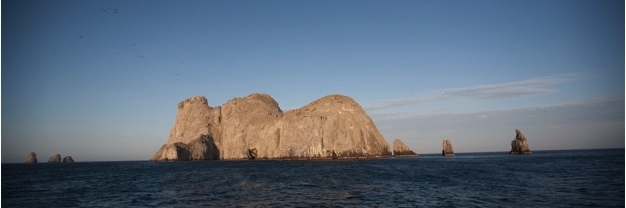
The crew sighted Malpelo Island Fauna and Flora Sanctuary on January 22, 2017.  Located more than 300 miles (500 km) off Columbia’s Pacific Coast, the Sanctuary includes the island of Malpelo and its rocky outcropping, as well as the surrounding 857,150 hectares of marine environment, and is the largest no-fishing zone in the Eastern Tropical Pacific.  This remote marine wilderness draws in divers and explorers with it’s unique terrain and high level of biodiversity.

Malpelo is home to 17 endemic species, including 5 fish, 2 seastars, 3 reptiles, 2 arthropods and 5 plants.  The Sanctuary also hosts impressive populations of apex and pelagic species, like Giant Grouper, Billfish, Tuna and numerous shark species, including the short-nosed ragged-toothed shark, a deepwater shark that is rarely seen close to shore.  Several seabirds can also be seen on Malpelo Island and it’s outcroppings, including Nazca and Masked Boobies, Swallow-tailed Gulls, and the critically endangered Galapagos Petrel.  “Other biodiversity highlights include 394 fish species, 340 species of mollusks, 17 marine mammals and 7 marine reptile species (UNESCO World Heritage Center, 2016).”

In 1994, UNESCO initiated a special project known as the World Heritage Education Programme, to give young people the opportunity to become involved in the protection of the world’s cultural and natural resources.  The Education Programme seeks to encourage and enable the decision-makers of tomorrow to participate in conservation and respond to the current challenges facing our wahi pana.

One of the primary tools used by the Education Programme to raise awareness of young people to the importance of World Heritage is the UNESCO World Heritage In Young Hands Kit.  It aims to sensitize young people to the importance of preserving their local, national and world heritage.  By promoting discussion, listening, diversity and mutual respect, the Kit serves as a valuable bridge for bringing together young people, educators, heritage specialists and other stakeholders, allowing them to learn together and from each other about their local and world heritage.

Interdisciplinary in nature, the Kit strives to incorporate World Heritage into the curriculum as a way of delivering core subjects and transverse themes in the classroom as well as through extra-curricular activities.  The lessons focus on creative and participatory methods of teaching that use student-centered and inquiry driven research, data collection and analysis; exercises in role-playing and simulation; experience with information and communication technology.  The In Young Hands Kit also invites educators to engage students through field trips and learning journeys.

National Geographic also has a lesson called Mapping World Heritage.  This 30 minute lesson is designed and can be adapted for grades 3 through 8.  Using pictures and clues, students learn about UNESCO World Heritage sites by identifying the locations of the sites on a large map. The lesson incorporates Math by having students use geographic coordinates to refine the locations of the sites and consider how geographic coordinates are part of a helpful system of location.

The Smithsonian Institute has also published World Heritage curricula and resources for educators.  One unique resource they offer is The World Heritage Game, an entertaining, interactive way of exploring the life of a World Heritage site. In the World Heritage Game, almost anything you can imagine could happen, does happen.  Students are tasked with operating a natural or historical tourist destination, and soon realize that it is more than just opening the gates and letting in the people. Special projects, unexpected events, and even natural disasters can often complicate, and add excitement, to the running of a world class site.


Ready to try out any of these lessons or resources? Email us at education@pvshawaii.org to share with us what you do with this content – we would love to see pictures and student reflections that we can share on social media and our website!

Doing another kind of project to mālama your community? Share Your Mālama Honua Story with us!

Are your students still in the beginning stages of identifying a problem they would like to try and solve? Don’t forget to check out the Mālama Honua Challenge and share your ideas about work that can be done in the future!

Continue Reading

Deadline Soon – Hawaiʻi Youth Sustainability Challenge

REMINDER – The deadline for this grant is coming up soon – January 29th, 2017!

Hawaiʻi students and teachers are invited to participate in the Hawaiʻi Youth Sustainability Challenge (HYSC), an initiative to inspire all youth to be intentionally engaged around our environment to become leaders and stewards of Hawaiʻi. The HYSC will provide students with the opportunity to apply for mini-grants to plan, design, prototype, and test their own small scale innovative and creative sustainability ideas and projects for their schools and communities. HYSC projects must be student-driven, Hawaiʻi specific, and with the potential to be scaled up for a larger impact project addressing the following:
1) Change you want to see in your school or community to support Hawaiʻi’s goal of achieving a sustainable future
2) Your environmental passions and desire for environmental education
3) Your motivation to make change for your school and community

Use the KHF Mini-Grant online application portal to get started!

HYSC Application Details:

  • Deadline for the HYSC Mini-Grant application is JANUARY 29, 2017. No applications will be accepted after this date.
  • HYSC mini-grants range from $150 – $1,000 per project application. (No more than $1,000 will be awarded per school.)
  • Awarded applicants will have checks made payable to and mailed directly to their schools, with 10% held until all project reporting documentation is received.
  • Hawaiʻi K-12 public, private, and charter schools are eligible to apply.
  • HYSC applications should be completed and submitted by student lead with the help of a teacher advisor. (Exceptions will be made for younger grade levels).

HYSC Applicants can submit their project ideas in the following ways:

  • Individually Powered Projects – One (1) student and one (1) teacher advisor working together
  • Group Powered Projects – Multiple students working together with one (1) student leader and one (1) teacher advisor. More than one teacher may collaborate on a project, but there should be one lead teacher advisor
  • School Collaboration Powered Projects – Two (2) or more schools are allowed and encouraged to collaborate on projects. There should be one (1) student leader and one (1) teacher advisor. More than one teacher may collaborate on a project, but there should be one lead teacher advisor

* HYSC Mini-Grants are to be used to purchase supplies or services for planning, designing, prototyping, and testing projects which inspire students and the local community to better connect with nature and take care of Hawaiʻi and its natural resources.

Screenshot 2016-12-14 11.52.13

Continue Reading

Hōkūleʻa Update | January 22, 2017

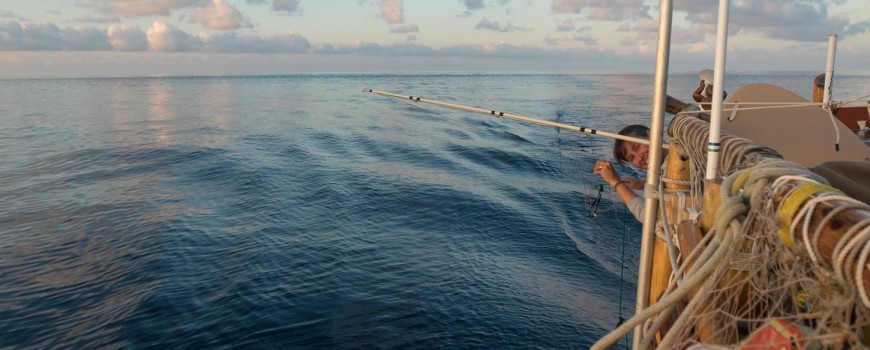
Today was another hot day in the doldrums with glassy seas and light winds. After spotting Malpelo Island shortly before sunset, the navigators decided to continue onto Galapagos. Breakfast consisted of boiled eggs, hash browns, bacon, and fresh papaya. Nearly all crewmembers jostle for the privilege of helping out with meal preparations and washing dishes. Throughout the day we have seen signs of marine life including the occasional turtle, gull, and dolphin. Sadly, we have been unable to catch any fish despite the efforts of Uncle Archie and Pam, who diligently put out our lines in the early dawn light. The crew is now settling in for another night aboard our mama waʻa, gently gliding along long ocean swells.

SB 72, Bryson Hoe


Homecoming__-_Save_the_Date_-_Banner

Hōkūle‘a Homecoming – Save the Date

Sign up for updates and be the first to know as we continue to detail homecoming festivities during the week of Hōkūleʻa’s homecoming
on June 17, 2017!

Continue Reading

Crew Blog | ʻAulani Wilhelm: Sighting Malpelo

aulani wilhelmBy ʻAulani Wilhelm

We sat at the bow looking out toward a late afternoon horizon. After discussing various perspectives about when we might actually see Malpelo, a small Colombian island 500 miles from the mainland, the apprentice navigators collectively decided it was time to begin the search before the sun began to set. We hoped to sight the molar-shaped island that juts abruptly up from the sea, before we sailed into the darkness. It had been another almost eerily calm day at sea, a bit cooler than the day before but still a scorcher – without the benefit of wind or wave to cool us down.malpelo

Malpelo, with its tiny rock outcrops surrounding it, is the only remaining emergent land (.46 sq mi) still visible in the entire underwater seamount chain which shares its same name. It was formed 17-20 million years ago, about the same age range as ʻŌnūnui, ʻŌnūiki, and Pūhāhonu (known as the Gardner Pinnacles) and Kamokuokamohoali’i (Maro Reef) in the northwestern Hawaiian Islands. At its tallest point, Malpelo is about 1,000 feet above sea level. Except for a small military post manned by the Colombian armed forces, it is uninhabited.

The underwater sanctuary is known for large aggregations of up to 1,000 sharks, including silky and hammerhead sharks. It is a top SCUBA destination due to its rich marine life and remarkably steep walls that descend to nearly 5,000 fathoms (30,000 feet).Malpelo_rock

Like Papahānaumokuākea, Malpelo Flora and Fauna Sanctuary is also a UNESCO World Heritage site known for its relatively undisturbed environment where marine species maintain their natural behavior patterns. Also like Papahānaumokuākea, it is one of only 16 Particularly Sensitive Sea Areas (PSSA) in the world designated by the International Maritime Organization. Last September Colombian President Juan Manuel Santos committed to double the size of the Sanctuary, which was already one of the largest no-fishing zones in the region.

As it had all day long, the ocean appeared vacant, with only limited sightings of wildlife – spinner dolphins, a handful of seabirds, and giant pilot whales in the far distance. Despite our best efforts to holoholo, the only response was the taking of one hook by what Archie Kalepa, our fisherman (among many other roles he has on the waʻa) predicted had been a shark. We were lucky, however, to spy three critically endangered leatherback turtles.

Looking for signs of an island, Archie and Nainoa spied a small flock of seabirds flying “with purpose,” as Mark Ellis described, in the general direction our apprentice navigators expected to see the island. They were not feeding and appeared to be returning home for the night. Squinted eyes scanned the horizon about 45 degrees in each direction looking for changes in clouds, shadows, and any aberration from the normal rise and fall of the waves at the edge of the sky. It takes a patient eye and particular focus to be successful. Despite all my efforts to look at the horizon, I was too easily distracted by the unusual currents and periodic debris I saw floating in the water.

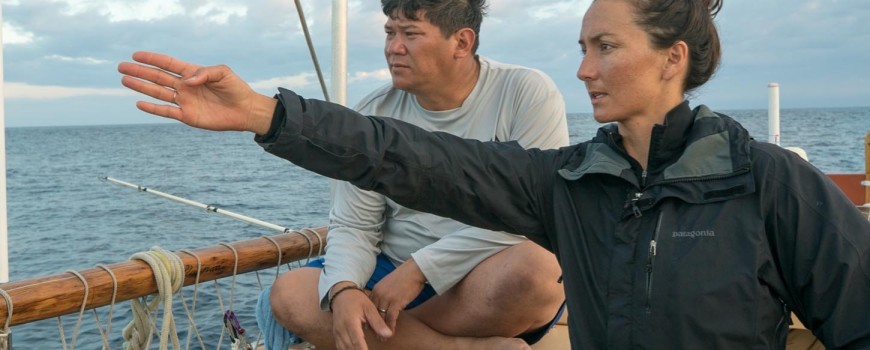
Quietly, Mark brought our attention to a particular patch of horizon just off the port side manu. He pointed to one edge of a small line of cirrus clouds and drew an imaginary line to the waterline. Very humbly he asked if anyone could see what he thought he saw, a small greyish shape that appeared, then disappeared with the motion of the swells. Archie, Jenna, Noe and I searched to find what he was showing us. One by one we each thought we saw what he described. But after staring toward a dusk light horizon on a bobbing canoe for a while, our minds and eyes seemed to play tricks on us, making us doubt what we thought we saw over and over again. We stayed patient. ‘It had to be there,’ I convinced myself.

After what seemed like an eternity, the grayish shape became clearer. A square with a flat top became increasingly stable, with a new line of clouds seeming to emerge from it. The team of navigators had successfully guided us to the island as a team, and Mark sighted his first island. A proud moment for them all, and a proud moment for their teachers on board. We all hugged.

It wasn’t the first time I saw someone pull an island out for the sea. Back in 2003 I watched Pwo navigator, Bruce Blankenfeld, quietly and seemingly effortlessly pull Nihoa island in Papahānaumokuākea out of the sea. It was amazing, of course. Today, however was differently amazing. I had witnessed the passing down of cultural knowledge manifest right before my eyes – evidence of the decades of untiring commitment and dedication of the many leaders and dedicated volunteers of the Polynesian Voyaging Society to ensure the ancient art and science of non-instrument, deep sea navigation lives on to carry future generations forward. What a privilege. We all sat quietly in celebration of each other and of those before us who brought us here.

Without navigational charts with sufficient detail to ensure we didn’t get in trouble sailing among the strong currents and surrounding seamounts, we kept the island at a distance, thanking her for her gift, and headed south towards the Galapagos. Malpelo allowed us to pull her out of the sea today, gifting us with tremendous navigational practice. It was an experience we will never forget.

Many thanks to the Parques Nacionales Naturales de Colombia, Sandra Bessudo from the Malpelo Foundation and my colleague Maria Claudia Diazgranados from Conservation International for your support in helping us get the necessary approvals to pass through this remarkable global treasure. This experience wouldn’t have happened without your kindness. We are grateful for the work you do to protect Malpelo on behalf of global humanity.

ʻAulani is a crewmember and Senior Vice-President for Oceans at Conservation International


Homecoming__-_Save_the_Date_-_Banner

Hōkūle‘a Homecoming – Save the Date

Sign up for updates and be the first to know as we continue to detail homecoming festivities during the week of Hōkūleʻa’s homecoming
on June 17, 2017!